Every business owner has probably looked at their website statistics and wondered the same thing:
“If hundreds of people are visiting my website every month, why aren’t more of them becoming customers?”
It can be incredibly frustrating.
You may have invested in a professional website. Perhaps you’re paying for SEO, Google Ads or other forms of digital marketing. The visitors are arriving exactly as you hoped, yet the number of phone calls, emails and enquiries remains disappointingly low.
The instinctive response is often to concentrate on generating even more traffic.
More visitors must mean more enquiries, right?
Not necessarily.
Sometimes the biggest opportunity isn’t attracting another thousand visitors. It’s persuading more of the people already visiting your website to take the next step.
At Peak District SEO, we’ve worked with businesses where relatively small improvements to a website and its customer journey have significantly increased enquiries without increasing traffic at all.
That’s because successful websites don’t simply attract visitors.
They guide them towards becoming customers.
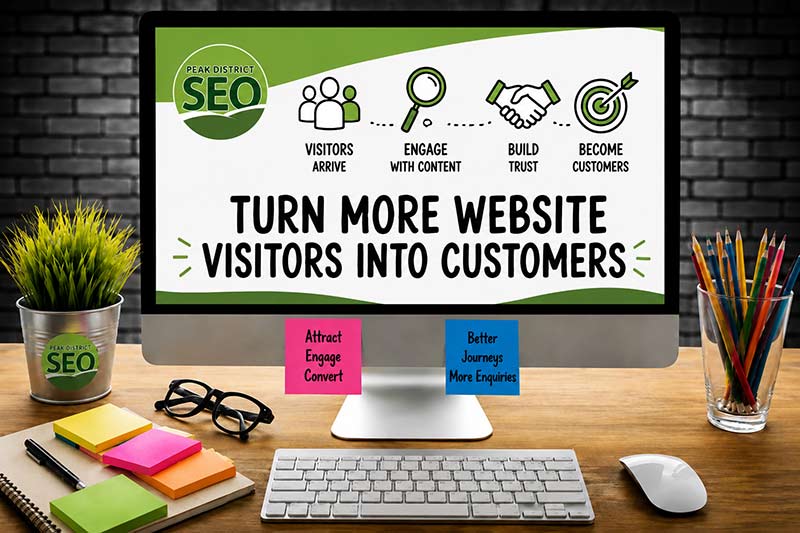
Every Website Visitor Arrives With a Question
People rarely visit a business website without a reason. In most cases, they’re trying to solve a problem, find information or make a decision.
They might be:
- Comparing several local companies
- Researching a particular service
- Looking for prices
- Checking reviews
- Trying to understand how something works
- Looking at examples of previous work
- Deciding whether they can trust your business
Whatever brought them to your website, there is usually a question behind their visit.
The sooner your website answers that question, the more likely they are to stay and continue exploring.
If the information is difficult to find, visitors are unlikely to spend several minutes hunting for it. Google is only a click away, and so are your competitors.
A successful website doesn’t make visitors work for information. It anticipates what they need to know and makes the answers easy to find.
First Impressions Decide More Than You Think
Before somebody reads your carefully written content, they’ve already started forming an opinion about your business.
- Does the website look professional?
- Is it easy to navigate?
- Does it feel trustworthy?
- Can they immediately understand what your business does?
- Does it look as though the website is regularly maintained?
These judgements happen remarkably quickly. People don’t consciously analyse every design choice, photograph or heading. Instead, they develop an immediate impression of whether a website feels credible. The same thing happens offline.
If you walked past two shops selling the same product and one looked clean, organised and welcoming while the other looked neglected, which would you enter first?
Your website creates a similar first impression. You only have a short period of time to reassure visitors that they’ve come to the right place.
Stop Assuming Visitors Understand Your Business
One of the easiest mistakes to make is forgetting how little a new customer knows about your company.
You understand your services because you work with them every day.
Your customers don’t.
Industry terminology that seems perfectly normal to you may mean absolutely nothing to somebody visiting your website for the first time.
Explain your services clearly. Avoid jargon where it adds nothing and answer the obvious questions a prospective customer is likely to have.
Tell people what you do, who you help and what they can expect if they contact you.
Good website content shouldn’t demonstrate how complicated your industry is.
It should make your industry easier to understand.
Trust Is Built Before Someone Contacts You
Many businesses think the sales process begins when somebody picks up the telephone or completes an enquiry form.
In reality, it starts much earlier.
- Potential customers may have already visited several pages before they make contact.
- Your homepage creates an impression.
- Your About page tells them who you are.
- Your case studies demonstrate your experience.
- Your reviews provide independent reassurance.
- Your photographs show the people, products or work behind the business.
- Your blog demonstrates knowledge.
- Even your contact page can influence whether somebody decides to get in touch.
- Visitors are quietly building a picture of your company throughout their visit.
Ask yourself a simple question:
“If somebody knew absolutely nothing about my business before visiting my website, would they leave feeling confident about contacting me?”
If the answer is no, increasing your traffic may not solve the underlying problem.
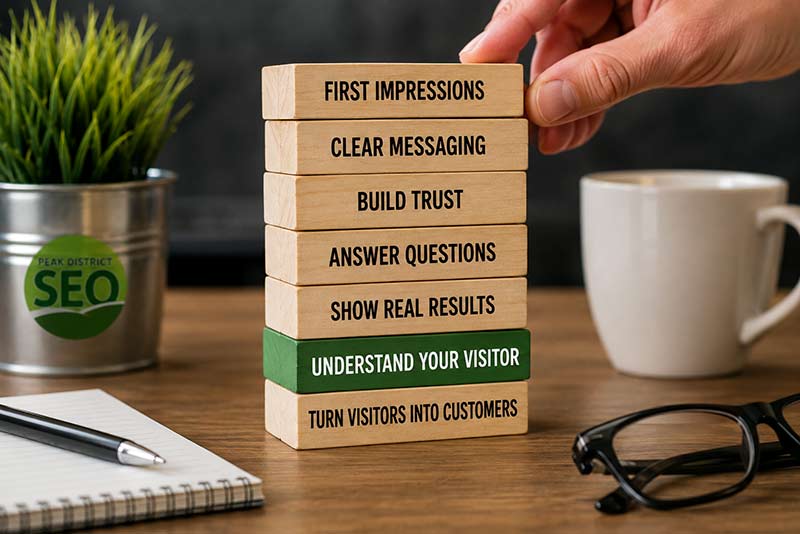
Remove the Reasons People Have for Saying No
Conversion optimisation isn’t simply about making buttons bigger or changing the colour of an enquiry form.
It’s about removing uncertainty.
Think about the questions somebody might ask before choosing your business.
Do they know roughly what your service costs?
Do they understand what happens after making contact?
Can they see examples of previous work?
Do they know which geographical areas you cover?
Can they easily find your telephone number?
Do you explain how long the process normally takes?
Can they see genuine customer reviews?
What happens if something goes wrong?
Every unanswered question introduces a little uncertainty.
One unanswered question probably won’t lose the customer. Five or six unanswered questions might.
Good websites systematically remove those doubts.
Don’t Make People Hunt for Information
We’ve all encountered websites where finding something simple feels like a treasure hunt.
- Contact details are buried in the footer.
- Services are hidden behind confusing menus.
- Important information is spread across several unrelated pages.
- Visitors shouldn’t need instructions to use your website.
- Navigation should feel natural.
Someone interested in a particular service should be able to find that service quickly. Someone who wants to telephone you shouldn’t have to search for your number. Someone who wants to see examples of your work should be able to find relevant case studies without returning to Google.
The easier your website is to use, the less friction there is between arriving and taking action.
Every Page Should Lead Somewhere
One of the biggest missed opportunities we see is the website page that simply stops.
The visitor finishes reading and…
That’s it.
There’s no suggestion about what to read next, no relevant case study, no invitation to make contact and no obvious next step.
Imagine visiting a showroom, looking at a product and then being completely ignored by the salesperson.
It would feel strange.
Your website should gently help visitors continue their journey.
For example, somebody reading about kitchen extensions might naturally want to know about planning permission, typical costs, timescales or previous extension projects.
Linking to that information isn’t simply good for SEO. It’s genuinely useful to the visitor.
It also creates a natural journey through the website.
Service page → useful guide → case study → testimonial → enquiry.
That’s far more persuasive than repeatedly displaying a button saying “GET A QUOTE”.
Show Evidence Rather Than Making Claims
Almost every business website makes claims.
- “We provide excellent customer service.”
- “We’re highly experienced.”
- “We provide quality workmanship.”
- “We put our customers first.”
There’s nothing necessarily wrong with these statements, but your competitors probably say exactly the same things.
Evidence is much more powerful.
Instead of simply saying you’re experienced, show examples of completed projects.
Rather than claiming your customers are happy, publish genuine reviews.
If you have relevant qualifications or accreditations, show them.
If you’ve won awards, mention them.
If your team has decades of combined experience, explain it.
If you’ve worked with recognised organisations, demonstrate that experience where appropriate.
Claims tell people what you want them to believe. Evidence gives them a reason to believe it.
Calls to Action Should Feel Helpful
Some websites turn every call to action into a sales pitch.
- BUY NOW.
- GET A QUOTE.
- CALL TODAY.
Sometimes that’s exactly what’s needed. However, not every visitor is ready to become a customer immediately.
- Someone searching for an emergency plumber probably wants a telephone number straight away.
- Someone researching a £30,000 home improvement project may spend several weeks comparing companies before making contact.
Your website should accommodate both.
Calls to action could encourage visitors to:
- Request a quotation
- Telephone your business
- Read a related guide
- View recent projects
- Read customer reviews
- Explore another service
- Send a question
- Arrange an initial conversation
The right call to action depends on where somebody is in their decision-making process.
Helping visitors take a small next step can eventually lead to the much bigger step of becoming a customer.
Your Website Should Continue the Conversation
Rather than thinking about individual website pages in isolation, think about your entire website as a conversation.
- A visitor asks a question.
- One page provides the initial answer.
- Another explains the subject in greater detail.
- A case study demonstrates that you have solved the same problem before.
- A testimonial provides reassurance from somebody who has already used your business.
- An About page introduces the people behind the company.
- Eventually, making contact feels like the logical next step.
That’s a much smoother customer journey than immediately asking someone to request a quotation when they know almost nothing about you.
Measure What Actually Matters
Website traffic can become addictive.
- Users.
- Sessions.
- Page views.
- Clicks.
- Impressions.
- Rankings.
All of these metrics can provide useful information, but none of them automatically represents commercial success.
The more important question is:
What did those visitors actually do?
Suppose a website receives 1,000 relevant visitors each month and generates 20 enquiries. That’s a 2% enquiry conversion rate.
Increasing traffic to 2,000 visitors while maintaining the same conversion rate could generate 40 enquiries.
But improving the original website’s conversion rate from 2% to 4% could also generate 40 enquiries, without attracting a single additional visitor.
The numbers will vary enormously between industries, businesses and types of enquiry, but the principle remains the same.
Getting more value from existing traffic can sometimes be more profitable than simply chasing more traffic.
Small Website Improvements Can Produce Big Results
The good news is that improving conversion rates doesn’t necessarily mean rebuilding your entire website.
Some of the most effective improvements can be surprisingly simple.
A clearer headline might help visitors understand your service immediately.
A genuine customer testimonial might remove uncertainty.
Better photographs might make your company feel more credible.
Improved internal links might help visitors find the information they need.
A shorter enquiry form might encourage more people to complete it.
A well-written case study might demonstrate exactly why someone should choose you.
Clearer pricing information might eliminate an important objection.
Individually, these changes can appear small.
Together, they reduce friction throughout the customer journey.
That’s when a website stops simply being somewhere people visit and starts becoming an effective part of the sales process.
Frequently Asked Questions
Why do people visit my website without contacting me?
There isn’t one universal reason. Common problems include unclear messaging, poor navigation, weak trust signals, unanswered questions and asking visitors to make contact before they feel confident enough to do so.
Look at the journey through your website from the perspective of somebody who has never heard of your company before.
What’s the biggest reason websites fail to convert visitors?
A common problem is asking for commitment too early.
Businesses understandably want enquiries, but visitors often need information and reassurance first. Your website needs to answer their questions and demonstrate why your company deserves their trust.
Do testimonials really help generate enquiries?
Genuine reviews and testimonials can be extremely valuable because they provide evidence from people who have already chosen your business.
Where possible, make testimonials specific. A detailed review explaining what you did and why the customer was pleased is usually more persuasive than a generic statement saying you provided “great service”.
Should every page include a call to action?
Every important page should provide an appropriate next step, but that doesn’t always have to be “Get a Quote”.
Sometimes the most useful next step is another guide, a relevant service page, a case study or examples of previous work. The aim is to help the visitor continue their journey.
Is getting more website traffic always the answer?
No. There’s an old saying:
“traffic is vanity, sales equals sanity”
If your existing traffic is relevant but very few visitors become enquiries or customers, increasing traffic may simply increase the number of people leaving without taking action.
Understanding why existing visitors aren’t converting can reveal opportunities that deliver a much better return.
Ready to Turn More Website Visitors Into Customers?
If your website is attracting visitors but isn’t generating the enquiries you expected, the answer may not be more traffic.
You may simply need to get more from the traffic you already have.
At Peak District SEO, we help businesses understand how people find and use their websites, then identify practical ways to improve the customer journey. That could mean clearer content, stronger calls to action, better internal linking, improved trust signals or removing obstacles that are preventing potential customers from getting in touch.
If you’re investing in SEO or Google Ads, every additional visitor has a value. Making your website better at converting those visitors can help you get more from that investment.
Contact Peak District SEO to discuss how we can help turn more of your website visitors into genuine enquiries and paying customers.
You may also like:
- Why Helpful Content Wins More Customers Than Constant Selling
- Digital PR and SEO: A Practical Guide to Building Authority and Visibility
- Do Backlinks Still Matter for AI Search?
- Why Your Website Should Answer Customer Questions

I’m Phil Gregory, the MD and founder of Peak District SEO.
I’m an SEO & Google Ads Consultant with 28+ years of experience in I.T and helping UK Businesses improve website performance.
I built my first website in 1998, then I discovered the joys of website optimisation and never looked back.
If you want a no-nonsense, no-hard-sell approach and to actually get your website fixed with a solid, affordable, long-term approach, hit the contact button today.
Peak District SEO is a UK-based Digital Marketing Company.
We help businesses make more money, using traditional Search Engine Optimisation (SEO) , Ai Search / GEO and paid advertising (PPC).
Why Peak District SEO?
27+ years of experience.
80+ 5* reviews on Google
Our customers have hundreds of page one and position 1 rankings, and we can prove it.
We’ve helped hundreds of SMEs in the UK
We have numerous articles published across the web discussing SEO.
We regularly publish case studies about the work we’ve done
Customers trust our service – See our reviews on Google, Trustpilot and Facebook
Our customers have hundreds of page one and position 1 rankings and we can prove it.