Pay-per-click advertising is one of the most effective forms of online advertising available to businesses today. At Peak District SEO, we use PPC advertising every day to help companies generate immediate traffic, measurable leads, and consistent sales through well-managed Google Ads and other paid advertising platforms.
If you are asking “what is PPC advertising?”, this guide explains the advertising model in detail. It covers how PPC works, where it is used, why it is so effective, and how businesses can build successful PPC campaigns that align with real business goals.
What Is PPC Advertising?
PPC advertising stands for pay-per-click advertising. It is a digital advertising model where advertisers pay a fee each time someone clicks on one of their ads. Instead of paying for visibility alone, businesses only pay when a user actively engages by clicking.
PPC advertising is commonly used in search engine advertising and social media ads. The most recognisable example is PPC search ads appearing at the top of a Google search results page when users enter relevant search queries.
This advertising model places ads in front of users who already show purchase intent. That makes PPC advertisements one of the most direct forms of online advertising available.
The Purpose of PPC Advertising
The primary purpose of PPC advertising is to drive targeted website traffic. Unlike organic traffic, which takes time to build through search engine optimisation, PPC delivers immediate traffic as soon as campaigns go live.
PPC marketing allows businesses to control budgets, target highly specific audiences, and focus on users with high purchase intent. When managed correctly, PPC campaigns support sales revenue, lead generation, brand awareness, and even long-term visibility when paired with SEO.
For small business marketing and eCommerce businesses alike, PPC advertising offers speed, control, and measurable performance.
Where PPC Advertising Is Used
PPC advertising appears across multiple advertising platforms. The largest PPC platform is Google Ads, which powers paid search ads across the Google search engine and the Google Display Network.
Other major PPC platforms include Microsoft Advertising, Amazon Advertising, LinkedIn Ads, Facebook Ads, and Instagram Ads. Each platform supports different advertising options, ad formats, and audience segments.
Search engine marketing remains the most popular PPC channel because it targets users based on their exact search query. Social media platforms, however, allow advanced targeting options using demographics, interests, behaviours, and audience segments.
Types of PPC Ads
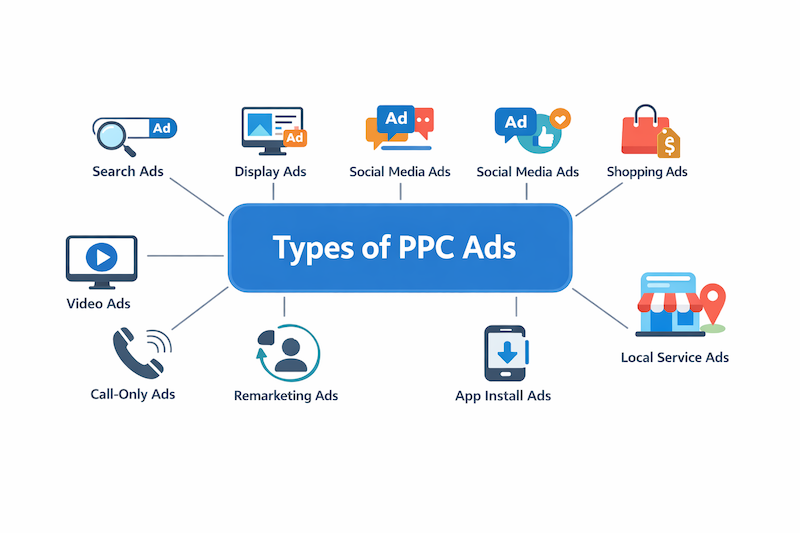
There are several different PPC advertisements used within paid advertising campaigns.
- PPC search ads are text-based ads that appear on the search engine results page. These ads match relevant search queries and keyword match types set within search campaigns.
- Display advertising uses banner ads across the Google Display Network and partner sites. Display ads are effective for brand awareness and remarketing.
- Video Ads appear on platforms such as YouTube and within social media feeds. These ads allow storytelling and strong visual engagement.
- Shopping ads are used heavily by eCommerce businesses. They show specific products, prices, and images directly in search results.
- Social media ads include promoted tweets, sponsored posts, and carousel ads across platforms like Facebook and Instagram.
Each ad format plays a different role within a digital marketing strategy.
Key Benefits of PPC Advertising
One of the main benefits of PPC advertising is control. Advertisers set daily budgets, target cost levels, and bidding strategies using a bid-based model or automated bidding.
PPC delivers immediate traffic, unlike organic results that require time and investment. Ads also provide valuable information through PPC metrics such as conversion rates, Cost Per Click, and click-through rates.
PPC campaigns allow precise keyword selection, demographic targeting options, and the ability to reach highly specific audiences. This leads to higher conversion rates and lower average cost when campaigns are optimised correctly.
For businesses competing in crowded markets, PPC can deliver first-page visibility even where there is strong competition.
How a PPC Campaign Is Set Up
Setting up a PPC campaign begins with business goals. A successful PPC campaign aligns tightly with specific business goals, whether that is leads, sales, or enquiries.
Keyword research is the foundation. Tools such as Google Keyword Planner and other keyword research tools help identify search volume, monthly searches, new keywords, and the right keywords to target.
The campaign structure follows next. This includes creating search campaigns, paid search campaigns, ad groups, and PPC search ads that closely match user intent.
Ad copy is written to include relevant ads, strong calls to action, and messaging aligned with landing pages.
Finally, a Google Ads account or other advertising account is configured with tracking, budgets, and bidding strategies.
Creating Effective PPC Ads
Effective PPC ads focus on relevance. The closer the ad copy matches the user’s search query, the higher the click-through rates tend to be.
Optimise ad copy by using clear benefits, strong calls to action, and limited-time offers where appropriate. Responsive Search Ads have changed PPC marketing by allowing Google Ads to test multiple headlines and descriptions automatically.
Advertisers should always align text ads with PPC landing pages that reinforce the same message and intent.
Optimising PPC Campaign Performance
PPC optimisation is an ongoing process. Campaigns improve through informed optimisation decisions based on real performance data.
Advertisers monitor campaign performance using PPC metrics such as conversion rates, lower CPC, clicks, and irrelevant clicks. Budgets are adjusted, keywords refined, and ad formats tested regularly.
Auction Insights Report and search auctions data help analyse competitors’ strategies and bidding behaviour. This allows advertisers to compete more effectively while managing advertising spend.
Tracking, Data, and Measurement
Tracking is critical to PPC success. Tools such as Google Analytics and Google Tag Manager connect advertising campaigns to real outcomes.
Tracking measures sales revenue, lead quality, website traffic, and overall performance. Without accurate tracking, optimisation decisions become guesswork.
Clear data is one of the strongest advantages PPC advertising offers over many other internet marketing channels.
PPC Advertising vs Organic Search
Understanding the difference between paid results and organic results on a search engine results page is vital.
Organic traffic supports long-term visibility and site authority through search engine optimisation. PPC advertising delivers immediate traffic and precise targeting.
The strongest digital marketing model combines PPC marketing and SEO to support both short-term results and long-term growth.
How Technology Has Shaped PPC Advertising
Technology advancements have transformed PPC advertising. Automated bidding, audience segmentation, machine learning, and Responsive Search Ads have improved campaign efficiency.
Modern PPC platforms now prioritise relevance, landing page quality, and user experience. Businesses that focus on valuable information and relevant ads achieve higher click-through rates and stronger ROI.
Frequently Asked Questions About PPC Advertising
How does search engine advertising differ from other online advertising?
Search engine advertising targets users actively searching for specific products or services, unlike display or social ads that interrupt browsing behaviour.
What role do landing pages play in PPC campaigns?
Landing pages convert traffic into leads or sales. Poor PPC landing pages reduce conversion rates and increase advertising costs.
How does Cost Per Click affect PPC budgets?
Cost Per Click determines how far a budget stretches. Lower CPC combined with high conversion rates delivers better ROI.
Why are Responsive Search Ads important in Google Ads?
Responsive Search Ads automatically test ad combinations, improving performance by matching ads more closely to user intent.
Speak to a PPC Specialist Today
If you want PPC campaigns that deliver measurable results, our team at Peak District SEO has proven experience delivering high-performing Google Ads campaigns for UK businesses.
Contact us today to discuss your PPC advertising strategy.

I’m Phil Gregory, the MD and founder of Peak District SEO.
I’m an SEO & Google Ads Consultant with 28+ years of experience in I.T and helping UK Businesses improve website performance.
I built my first website in 1998, then I discovered the joys of website optimisation and never looked back.
If you want a no-nonsense, no-hard-sell approach and to actually get your website fixed with a solid, affordable, long-term approach, hit the contact button today.
Peak District SEO is a UK-based Digital Marketing Company.
We help businesses make more money, using traditional Search Engine Optimisation (SEO) , Ai Search / GEO and paid advertising (PPC).
Why Peak District SEO?
27+ years of experience.
80+ 5* reviews on Google
Our customers have hundreds of page one and position 1 rankings, and we can prove it.
We’ve helped hundreds of SMEs in the UK
We have numerous articles published across the web discussing SEO.
We regularly publish case studies about the work we’ve done
Customers trust our service – See our reviews on Google, Trustpilot and Facebook
Our customers have hundreds of page one and position 1 rankings and we can prove it.