Why Old-School Directory Backlinks Still Matter for Your SEO
Directory backlinks have a slightly dusty reputation. Mention business directories to some marketers, and they picture bulk-submission software, thousands of near-identical listings and an inbox full of promises about instant Google rankings. That version of directory link building deserves to stay in the past.
However, useful business directories have not disappeared. Customers still use local directories, professional registers, trade associations, supplier databases, chambers of commerce and specialist marketplaces to find trustworthy companies. Search engines can also discover and interpret the public information these sites contain.
The important distinction is quality and purpose. A directory backlink is not valuable merely because it is a backlink. It becomes worthwhile when the directory serves a genuine audience, verifies or organises useful business information, and places your company in a context that makes sense.
At Peak District SEO, we still consider relevant directory backlinks when building an SEO strategy for a local, regional or specialist business. We do not recommend mass submission to every directory that will accept a URL. We use professional software that only prospects directories of value. This delivers credible listings that improve business discovery, reinforce accurate information and may send qualified referral traffic.
What Is a Directory Backlink?
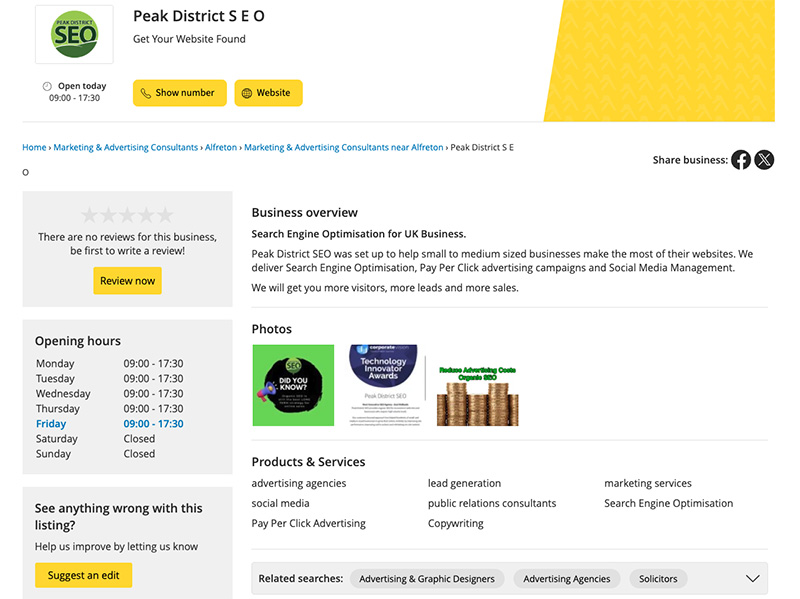
A directory backlink is a link from an online directory profile or listing to your website. A listing may include your company name, address, telephone number, website, opening hours, service categories, geographical coverage, photographs and a short description.
Directories take many forms. They include general business directories, local authority or town directories, trade associations, membership organisations, professional registers, tourism databases, manufacturer-approved supplier lists and tightly focused industry platforms.
The phrase directory backlink therefore covers very different things. A listing on a respected professional body is not equivalent to a page on an abandoned website containing thousands of unrelated links. Treating them as identical is one reason businesses either dismiss directories completely or waste money on poor-quality submissions.
Why Directory Backlinks Became Forgotten
Directory submission was once an easy way to create large numbers of links. Free automated tools could place the same business description across hundreds of sites. Exact-match anchor text was often used in an attempt to influence rankings.
Search engines became much better at recognising manufactured link patterns. Google’s current spam policies identify links from low-quality directory or bookmark sites as an example of link spam when links are created primarily to manipulate search rankings. Google also warns against automated link creation and other schemes designed to manufacture ranking credit.
That does not mean every directory listing is harmful. It means the old objective of accumulating the largest possible number of links is obsolete. A legitimate listing should exist because the directory has a real purpose for users, not because somebody created an empty catalogue to sell backlinks.
The modern question is not, “How many directories can we join?” It is, “Which directories would a customer, partner or search engine reasonably expect this business to appear in?”
Seven Reasons Good Directory Backlinks Still Matter
1. They Help Customers Discover Your Business
A directory can send direct referral traffic. This is the most straightforward benefit and is sometimes overlooked because marketers concentrate on link authority.
A person browsing a local business network, professional register or specialist supplier database may already be looking for a company like yours. That visitor is often more commercially relevant than somebody arriving from a broad informational search.
Measure directory performance through referral visits, calls, enquiries and assisted conversions where possible. A listing that regularly generates genuine prospects has value even if its direct effect on rankings cannot be isolated.
2. They Create Useful Local & Topical Context
A relevant directory places your business alongside organisations connected by location, profession or service. That context can help users understand what you do and where you operate.
For example, a Derbyshire business listed by a local chamber of commerce has a logical geographical relationship with that website. A specialist contractor listed by a recognised trade association has a clear topical relationship. These are more meaningful than a random link from a global directory containing every imaginable industry.
Context matters because links are not evaluated in a vacuum. The surrounding page, directory category, business description and purpose of the website all contribute to the meaning of a listing.
3. They Reinforce Accurate Business Information
Directory listings often publish core business details. Keeping the company name, address, telephone number, website and trading information accurate reduces customer confusion.
Google advises businesses to keep information in their Business Profile complete and up to date because accurate information helps customers understand what a company does, where it operates, and when it is available. That principle is sensible across the wider web too.
Consistency should not become a mechanical obsession over punctuation. The goal is recognisable, accurate business information. Correct old addresses, broken URLs, duplicate profiles and obsolete telephone numbers before creating new listings.
4. They Can Support Brand Verification and Trust
Prospective customers rarely assess a company through one page. They compare search results, reviews, social profiles, professional memberships and third-party references.
A coherent set of credible listings can reassure people that a business is established and contactable. A verified trade membership or local business profile may support trust more effectively than a dozen self-created marketing pages.
Directory backlinks should therefore form part of a wider reputation and entity strategy. They are supporting evidence, not a substitute for a useful website, genuine customer reviews, expert content or strong service delivery.
5. They Help Search Engines & AI Systems Find Corroborating Information
Search engines crawl links to discover pages and understand relationships across the web. Google’s documentation explains that crawlable links help Google find pages, while descriptive anchor text helps people and Google make sense of the linked content.
Modern search also extends beyond a list of blue links. AI-assisted systems seek clear, corroborated information about organisations, services and locations. No directory can guarantee a mention in ChatGPT, Gemini, Perplexity, Claude or Google’s AI experiences. Nevertheless, consistent information across trustworthy public sources makes a business easier for both people and machines to identify correctly.
This is not a reason to create hundreds of synthetic citations. It is a reason to maintain accurate profiles on sources that genuinely describe your organisation.
6. They Can Diversify a Natural Backlink Profile
A healthy backlink profile rarely consists of one link type. It may contain editorial coverage, supplier links, customer references, professional memberships, local sponsorships, case studies, citations and useful directories.
Relevant directory backlinks can be a modest part of that mixture. They are particularly practical for new businesses that have not yet earned substantial press or editorial coverage.
The emphasis must remain on relevance. Ten carefully selected listings are usually preferable to a thousand automated submissions. Diversity does not mean collecting every link available. It means earning and maintaining different legitimate signals created through normal business activity. Some examples are:
| by Facebook |
| 192.com |
| Acompio UK |
| Amazon Alexa |
| American Express |
| Apple |
| AroundMe |
| Bing |
7. They Reveal Commercial Opportunities Beyond SEO
Researching directories can uncover networking groups, procurement platforms, events, awards, partnerships and membership opportunities. The backlink may be the least interesting outcome.
A manufacturer might discover a recognised supplier register. A tourism business may find a destination database used by visitors. A professional-services company could join a chamber whose directory also produces referrals and introductions.
This is why Peak District SEO assesses directory opportunities commercially as well as technically. The best listing should make sense even if Google ignored the link tomorrow.
Which Directories Are Worth Using?
- A directory deserves consideration when it meets several of the following tests.
- It has a real audience. The website exists to help people find, compare or verify relevant organisations.
- It is locally or professionally relevant. The directory clearly relates to your location, industry, accreditation, supply chain or customer market.
- Listings are reviewed or curated. Some form of moderation, membership requirement or verification usually improves quality.
- The site is maintained. Pages load correctly, recent listings exist and contact information is current.
- The category is sensible. Your listing will sit beside genuinely comparable businesses rather than unrelated websites.
- The profile contains useful information. Customers can learn what you offer, where you operate and how to contact you.
- The website has its own visibility or reputation. Search for the directory’s brand and examine whether its category pages appear in relevant searches.
- The listing has commercial value without the backlink. This is the strongest test. If you would still want the profile for referrals, credibility or membership, it is more likely to be legitimate.
Top 10 Directories by Estimated Web Traffic
This ranks the consumer-facing domains associated with your list. “Annual traffic” is a run-rate calculated from Similarweb’s May 2026 worldwide visit estimate × 12—not twelve months of observed directory traffic.
| Rank | Directory/platform | Monthly web visits | Annualised visits | What users commonly say about local discovery |
|---|---|---|---|---|
| 1 | Google Business Profile / Google Maps | 87.5B* | 1.05T* | Excellent coverage, reviews and “near me” discovery. Recurring complaints concern fake reviews/listings, unexplained suspensions, incorrect merges and slow support. |
| 2 | Meta Places Graph / Facebook | 11.8B* | 141.6B* | Community recommendations and local groups can be valuable. Users report stale pages, duplicates, spam and difficulty correcting ownership or location data. |
| 3 | 7.4B* | 88.8B* | Strong for seeing a business’s work, atmosphere and recent activity. Weak for structured information such as hours, accessibility, pricing and precise local search. | |
| 4 | OpenAI / ChatGPT | 5.6B* | 67.2B* | Convenient for producing a short, personalised shortlist. Users warn that recommendations can omit real businesses, mix entities together or confidently repeat outdated information. |
| 5 | TikTok | 3.6B* | 43.2B* | Particularly effective for restaurants, beauty, travel and visually demonstrable services. Users question sponsored content, influencer bias and whether viral recommendations remain accurate. |
| 6 | Bing / Bing Places | 3.5B* | 42.0B* | Useful secondary exposure and integration with Microsoft products. Business owners frequently mention incorrect addresses, mismatched listings, delayed updates and limited support. |
| 7 | Gemini | 2.9B* | 34.8B* | Convenient integration with Google’s local information. Users report missed obvious matches, inconsistent answers and occasional unsupported claims about smaller businesses. |
| 8 | Yandex / Yandex Maps | 2.8B* | 33.6B* | Strong local relevance in its core markets and a useful native review system. Criticism centres on geographic limitations, satellite detail and navigation problems where GPS is disrupted. |
| 9 | Amazon / Alexa | 2.6B* | 31.2B* | Users value enormous product coverage and plentiful reviews. They remain wary of fake reviews, sponsored ranking and recommendations that feel commercial rather than impartial. |
| 10 | Brave / Brave Search | 581.2M* | 7.0B* | Privacy and reduced tracking are appreciated. Local searches receive criticism for weak localisation and results from the wrong country or region. |
*These figures represent traffic to the entire parent domain—not specifically its directory, maps or business-listing component. The underlying May 2026 estimates are published in Similarweb’s worldwide website ranking.
Interpretation
The enormous numbers at the top are not evidence that their directories alone receive that traffic. Google’s estimate includes general search; Facebook and Instagram include social activity; Amazon includes shopping; and ChatGPT/Gemini include every kind of conversation.
The practical conclusions are:
- Google is the indispensable listing. It combines reach, local intent, maps and reviews, despite persistent trust and support complaints.
- Instagram and TikTok are discovery channels rather than conventional directories. Their value is visual evidence and cultural relevance.
- ChatGPT and Gemini are emerging recommendation layers. Their reach is substantial, but inconsistent source data can make their local answers unreliable. Recent user testing found different assistants naming different businesses for identical local queries.
- Bing and Meta matter as data sources and syndication endpoints, even where direct local-search traffic is much smaller than their headline domain traffic.
- Traffic alone undervalues Apple Maps, Siri, Alexa, Waze and Snapchat. Much of their usage occurs inside apps, voice interfaces or operating systems and therefore does not appear as ordinary website visits.
The feedback synthesis is supported by reports of Google listing manipulation and fake reviews, Bing listing mismatches, AI recommendation inconsistencies, and Brave’s localisation limitations. This is a qualitative synthesis of recurring comments, not a statistically representative satisfaction survey.
Which Directory Backlinks Should You Avoid?
Avoid directories whose primary sales pitch is link quantity, PageRank-style metrics or guaranteed ranking improvements. Be cautious when every listing uses keyword-heavy anchor text, unrelated categories are mixed together or the site has no obvious human audience.
Other warning signs include:
- automated submission to thousands of sites
- Free submission sites – it used to work, now it’s just trash and spam
- payment solely for a followed link
- directories filled with gambling, adult, pharmaceutical or obviously hacked pages
- no moderation or meaningful business information
- pages that are not indexed or cannot be reached through normal navigation
- aggressive reciprocal-link requirements
- expired certificates, broken pages or abandoned contact details
- promises that a fixed number of directory links will guarantee rankings
Google’s spam policies are clear that links created mainly to manipulate rankings can be treated as link spam. If a paid listing has legitimate advertising value, the directory should apply appropriate link qualifications such as rel=”sponsored” or rel=”nofollow” where required. Paying for exposure is not inherently wrong. Paying specifically to pass ranking credit is the danger.
How to Build Directory Backlinks Properly
Start With an Audit
Search for your company name, telephone number, previous addresses and domain. Identify existing profiles, duplicates and errors. Correct strong profiles before opening new ones.
Prepare Accurate Source Information
Create a master record containing your official business name, address, telephone numbers, website, opening hours, service areas, concise description, longer description, logo, photographs and key contact details.
Do not force identical wording everywhere. Facts should remain consistent, but descriptions can be adapted to the directory’s audience and category.
Choose the Right Destination Page
Most company listings should link to the homepage or a strong location page. A specialist directory may justify linking to a directly relevant service page. Avoid stuffing anchors with commercial keywords. A branded or naturally generated link is normally more appropriate.
Complete the Whole Profile
A thin listing containing only a name and link offers little value to users. Add accurate categories, services, photographs, opening hours and other requested information. Write a description that explains the business rather than repeating keywords.
Record Ownership and Access
Keep a secure register of profile URLs, login accounts, verification methods, renewal dates and listing status. This prevents profiles becoming stranded when an employee or agency relationship changes.
Review Listings Periodically
Check important profiles after an address, telephone, domain, opening-hour or service change. Remove duplicates and monitor referral traffic. A directory strategy is partly a data-maintenance task.
Do Directory Backlinks Improve Rankings?
They do contribute to a broader SEO strategy, but no responsible consultant can promise that directory links alone will move a website to the top of Google.
A relevant directory link may help search engines discover a website, provide topical or geographical context and form part of a natural link profile. A strong listing may also send qualified traffic and reinforce brand information. However, the impact varies according to the directory, the competing search results, the quality of your website and the rest of your backlink profile.
Directory links cannot compensate for technical problems, weak content or an uncompetitive proposition on your website. They work best alongside a properly structured website, useful service pages, local optimisation, digital PR, genuine reviews and editorial link earning.
Directory Backlinks & Local SEO
Directories are especially relevant to local businesses because customers often search through location-based and category-based sources.
Local SEO requires a clear relationship between a business, its services and its operating area. Accurate profiles on respected local organisations can support that picture and provide routes for customers who do not begin their journey on your website.
Prioritise sources such as local chambers, recognised business networks, destination organisations, local authority resources where appropriate, and genuine regional industry groups. National directories can still be useful, but locality and category should be explicit.
Peak District SEO helps businesses in Derbyshire and throughout the UK assess these opportunities without turning local SEO into a box-ticking exercise. The objective is to be present where customers reasonably expect to find you.
Directory Backlinks for Specialist and B2B Companies
Specialist directories may be particularly valuable in business-to-business markets. Procurement teams, specifiers and partners often use approved supplier lists, trade-body databases and membership directories.
These profiles can communicate accreditations, capabilities, sectors, geographical coverage and contact routes. They may produce fewer visits than a general consumer directory, but the visitors can be much more relevant.
A B2B company should map the organisations that influence buying decisions. Consider trade associations, accreditation bodies, manufacturers, distributors, professional institutes, industry publications and event communities. The resulting opportunities are often more defensible than generic link-building lists.
How Peak District SEO Approaches Directory Link Building
Peak District SEO does not treat directory submissions as a numbers contest. Our process begins with the company, its market and its existing digital footprint.
We review current listings, identify errors and look for sources that have genuine local, professional or commercial relevance. We assess whether a directory is maintained, whether it serves users and whether the listing supports the broader SEO strategy. We use professional, paid software to help make this task easier and more efficient.
Where a listing makes sense, we help prepare accurate information and choose the appropriate website destination. We also consider how directory profiles fit alongside link building, local SEO, content development and reputation management.
This measured approach takes a little work and coordination with our clients, but we find it to be worth the effort. It is also safer, more useful to customers and better aligned with modern search-quality principles.
Frequently Asked Questions About Directory Backlinks
Are directory backlinks still good for SEO?
Relevant, reputable directory backlinks can still be useful. They may help customers discover a business, reinforce accurate information, create local or topical context and contribute to a varied backlink profile. Low-quality directory links created mainly to manipulate rankings should be avoided.
How many directory backlinks do I need?
There is no correct number. A specialist company may have only a handful of worthwhile trade and professional directories. A multi-location business may need more profiles. Quality, accuracy and commercial relevance matter more than volume.
Should I pay for a directory listing?
Pay when the listing provides genuine membership, advertising, referral or visibility value. Do not pay solely for ranking credit. Paid links should be qualified appropriately under Google’s guidance. Assess the audience and benefits before judging the listing by its backlink metrics.
A sensible planning average is 15 minutes per directory. An average full list of around 58 destinations would therefore represent roughly 14.5 staff-hours for initial submissions—realistically 18–22 hours after verification emails, failed submissions and corrections.
Assuming the business’s name, address, phone number, opening hours, categories, description, website, logo and photos are already assembled. Many destinations on your list are data partners, apps or AI services rather than directories with public submission forms, so the actual number of manual submissions should be considerably lower.
| Submission situation | Typical time |
|---|---|
| Simple form; details prepared | 5–10 min |
| Standard directory with account and categories | 10–15 min |
| Photos, description and verification required | 15–30 min |
| Complicated verification or duplicate listing | 30–60+ min |
The value lies in paying an SEO company to do the work for you. They will create the listings, ensure that they are submitted, maintained, updated and synced, removing inconsistent listings and fixing and replacing broken listings. This is something that’s difficult to manage if you do it in-house, as all passwords must be saved, and staff turnover can often break the process.
Do all directory listings need exactly the same business description?
No. Core facts should remain accurate and recognisable, but descriptions can be written for each directory’s audience. However, a comprehensive core message helps with consistency.
Can directory backlinks hurt my website?
A small number of poor links is not automatically a disaster, but deliberate participation in automated or manipulative link schemes creates unnecessary risk. Avoid mass-submission packages and low-quality directory networks. If you inherit a suspicious backlink profile, obtain professional advice before taking drastic action.
What are the best directories for a UK business?
The best choices depend on the business. Begin with relevant professional bodies, trade associations, local chambers, reputable regional organisations and specialist platforms used by customers. A generic “top 100 directories” list cannot account for your market or location.
Do nofollow directory links have value?
Yes. A nofollow or sponsored link may still send referral traffic, support brand discovery and provide a useful public profile. A link does not become worthless simply because it does not pass conventional ranking credit.
Old School Does Not Have to Mean Outdated
Directory backlinks still matter when the directory itself matters. A curated listing on a website used by real customers can improve discovery, trust and information consistency while contributing to a broader digital footprint.
What no longer works is treating directories as a mechanical shortcut to rankings. The days of mass submission, spun descriptions and exact-match anchor text should be left behind.
The modern version of directory link building is selective. It favours real organisations, accurate profiles, local and industry relevance, customer usefulness and measurable commercial outcomes.
If you are unsure which directory backlinks are helping, which listings need correcting or where your competitors are earning credible mentions, Peak District SEO can review your backlink profile and build a practical link-development plan.
Contact Peak District SEO to discuss local SEO or link-building campaigns designed around your business. We can grow your visibility whilst you get on with running your business.
You May Also Like
- Agency Link Building: The Definitive Guide to Building Backlinks That Drive Real Results
- What Is EEAT and What Does It Mean for SEO?
- What Happens When You Change a URL?
- Local Ads Campaigns & Understanding Their Limitations
Sources and Further Reading
- Google Search Central, Spam Policies for Google Web Search
- Google Search Central, SEO Link Best Practices
- Google Business Profile Help, Tips to Improve Your Local Ranking on Google
- Peak District SEO, Link Building Service

I’m Phil Gregory, the MD and founder of Peak District SEO.
I’m an SEO & Google Ads Consultant with 28+ years of experience in I.T and helping UK Businesses improve website performance.
I built my first website in 1998, then I discovered the joys of website optimisation and never looked back.
If you want a no-nonsense, no-hard-sell approach and to actually get your website fixed with a solid, affordable, long-term approach, hit the contact button today.
Peak District SEO is a UK-based Digital Marketing Company.
We help businesses make more money, using traditional Search Engine Optimisation (SEO) , Ai Search / GEO and paid advertising (PPC).
Why Peak District SEO?
27+ years of experience.
80+ 5* reviews on Google
Our customers have hundreds of page one and position 1 rankings, and we can prove it.
We’ve helped hundreds of SMEs in the UK
We have numerous articles published across the web discussing SEO.
We regularly publish case studies about the work we’ve done
Customers trust our service – See our reviews on Google, Trustpilot and Facebook
Our customers have hundreds of page one and position 1 rankings and we can prove it.