At Peak District SEO, keyword research for SEO sits at the very heart of everything we do for our clients. Whether we are optimising a single sales page or architecting a full content marketing strategy, the keyword research process is the foundation upon which every successful SEO effort is built. Without it, even the most beautifully written content risks being invisible on the search engine results pages (SERPs) that matter most to your business.
This guide has been written to give business owners, marketers, and digital teams a thorough, practical understanding of keyword research for SEO. From the basics of what it is and why it matters, through to the tools, techniques, and tracking methods that separate average strategies from outstanding ones, everything you need is covered here. And if you want expert help putting it all into practice, Peak District SEO has a proven, hands-on solution for keyword research across pages, categories, products and blogs.

What Is Keyword Research for SEO?
Keyword research is the process of finding and analysing the search terms that real people type into search engines such as Google when they are looking for information, products, or services. It is, in essence, listening to your target audience at scale. The goal is to identify which words and phrases will attract valuable, qualified traffic to your website, and then to use those insights to shape your content, on-page SEO, and broader digital marketing strategy.
The keyword research process involves far more than simply compiling a list of words. It requires an understanding of search volume data, keyword difficulty, user intent, competition data, and the relationship between individual terms and broader topic clusters. Done properly, it reveals not just what people search for, but why they search for it, which is the real basis for creating SEO-optimised content that ranks and converts.
At Peak District SEO, we believe that thorough and continuous keyword research is one of the key pillars of successful search engine optimisation. It cannot be treated as a one-off task. Markets shift, competitors evolve, and user intent changes over time, which means your keyword strategy must be regularly reviewed and refreshed.
Why Keyword Research Is Important for SEO Success
The importance of keyword research for SEO in developing a successful digital marketing strategy cannot be overstated. Every time someone searches online, they are signalling their needs, problems, and intentions. By identifying the right target keywords, your website is positioned to answer exactly those signals, which is precisely how organic search results are earned rather than paid for.
Consider the practical impact. Ranking for the right keywords means your pages, categories, products, and blog posts appear in front of people who are already looking for what you offer. This drives search traffic that is far more likely to convert than traffic from paid ads, because the user intent is already aligned with your offering. The click-through rate from organic search results, when you rank prominently for relevant keywords, consistently outperforms many other marketing channels in the long run.
Furthermore, effective keyword research supports brand awareness, helps you understand your niche, and informs the entire content marketing strategy your business deploys. It also reveals new ranking opportunities you may never have considered without the data. At Peak District SEO, we regularly uncover hidden keyword gaps for our clients that, when addressed, deliver measurable improvements in rankings and qualified traffic.
Understanding the Different Types of Keywords
Seed Keywords
Seed keywords are the broad, foundational terms that define your business area or niche. They are the starting point of any keyword research process. For example, a business selling outdoor clothing in the Peak District might begin with seed keywords like “walking gear” or “waterproof jackets”. From these seeds, an entire keyword universe is grown using dedicated keyword research tools and techniques.
Short-Tail and Long-Tail Keywords
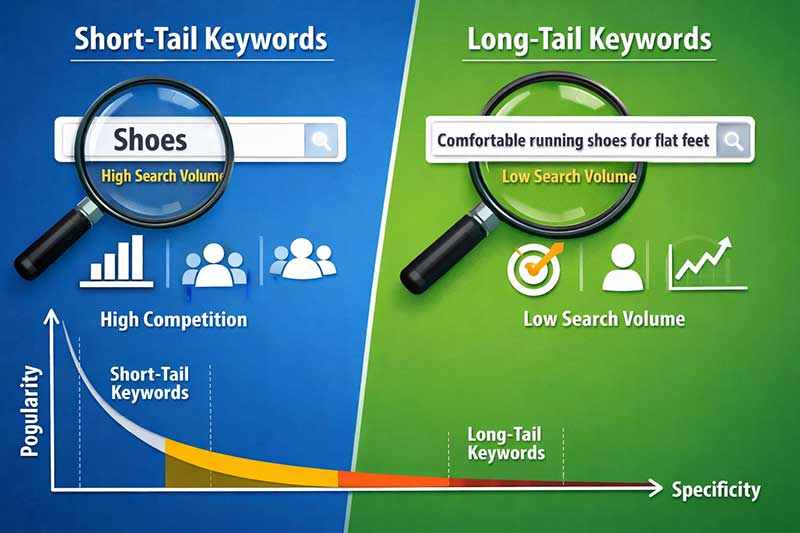
Short-tail keywords are broad, high-volume search terms, usually one to two words in length. They carry a higher search volume but come with significantly higher competition. Ranking for these terms is challenging and time-consuming, particularly for newer websites competing against established domains.
Long-tail keywords, by contrast, are longer and more specific phrases. They typically carry a lower search volume individually, but they attract more qualified traffic because they reflect a clearer user intent. A searcher typing “best waterproof walking boots for women Peak District” is far further along the buying journey than someone who searches simply “boots”. Long-tail keywords are particularly powerful for product pages, category pages, and blog content, and they are an area in which Peak District SEO specialises when conducting keyword research for your pages, categories, products, and blogs.
It is also worth noting that the higher the search volume of a keyword, the more competitive it tends to be. However, this is not a universal rule. Niche terms within a specific topic can carry reasonable monthly search volume whilst presenting lower competition, making them excellent targets for a well-constructed SEO strategy.
Understanding User Intent: The Engine Behind Every Search
User intent, sometimes called search intent, refers to the underlying reason why someone performs a particular search. Google’s entire algorithm is designed to match results to intent, which means any SEO-optimised content that ignores this principle will struggle to rank, regardless of how well the on-page elements are optimised.
There are four primary categories of user intent.
Informational intent
Informational intent is present when a user is searching for general or helpful information on a topic. These searches are often broad and exploratory, such as “how does keyword research work”. The goal here is learning, understanding, or finding answers to questions.
Navigational intent
Navigational intent occurs when a user is trying to reach a specific website, page, or brand. These searches are usually very direct, such as typing a company name, product name, or URL into a search engine. For example, a user searching for “Peak District SEO” is likely trying to find that exact website rather than explore alternatives.
Commercial intent
Commercial intent covers searches where a user is researching before making a purchase decision. They may be comparing products, reading reviews, or looking for the best options available. Queries often include phrases like “best”, “top”, or “reviews”, indicating consideration but not yet commitment.
Transactional intent
Transactional intent is the clearest buying signal. It indicates that the user is ready to take action, such as making a purchase, booking a service, or submitting an enquiry. Searches may include terms like “buy”, “order”, “book”, or “get a quote”, showing strong intent to convert.
At Peak District SEO, mapping user intent to keyword selection is a core part of the keyword research process. Informational intent keywords are best served by blog content and guides. Commercial intent keywords suit category pages and comparison content. Transactional intent keywords are the domain of product pages and sales pages. Getting this alignment right is the difference between traffic that bounces and traffic that converts.
How to Conduct Keyword Research: A Practical Step-by-Step Process
Step 1: Define Your Seed Keywords and Niche
Begin by identifying the core themes of your website, business area, and specific niche. Write down every relevant topic, product category, and service. These form your initial seed keywords. Think from the perspective of your target audience: what search terms would they use in the search bar to find what you offer?
Step 2: Use a Dedicated Keyword Research Tool
Using a dedicated keyword research tool is the most efficient way to expand from seed keywords into a comprehensive list of target keywords. The following tools are widely used across the industry, and each has distinct advantages.
- Semrush Keyword Magic Tool:
The Keyword Magic Tool from Semrush is one of the most powerful options available. It generates thousands of keyword suggestions from a single seed keyword, including phrase match variants, and provides monthly search volume, keyword difficulty, and competition data. The Keyword Overview tool within Semrush gives a rapid assessment of any individual term. - Ahrefs Keyword Explorer:
The Ahrefs Keyword Explorer is highly regarded for the depth of its metrics, including estimated organic traffic, ranking difficulty, and detailed data on top-ranking pages. It is particularly useful for keyword gap analysis, which involves identifying the keywords your competitors rank for that you do not. - Moz Keyword Explorer:
The Moz Keyword Explorer offers actionable insights around keyword difficulty and organic competition, and its Priority score helps you identify the most valuable terms for your specific website. It integrates well with Moz’s broader suite of SEO tools. - Google Keyword Planner:
The Google Keyword Planner, accessible via a Google Ads account, provides search volume data directly from Google’s own infrastructure. It is a free tool that offers reliable search volume data, though the data is often presented in broad ranges rather than precise monthly figures unless you have an active Google Ads campaign running. - Google Search Console:
The Google Search Console is an indispensable free tool for understanding how your existing keywords are performing. By connecting a Search Console account, you can see which search terms already bring impressions and clicks to your site, revealing existing content that can be optimised further.
There are also useful free tools worth incorporating into your workflow. Keyword Surfer is a Chrome extension that overlays search volume data directly into Google search results. Google Autocomplete, sometimes called Google Suggestions, surfaces real-time data on what users are searching for as you type into the search bar. Google Trends is excellent for understanding keyword trends over time and spotting seasonal patterns in search traffic. These useful tools complement the more data-heavy platforms and are particularly valuable for content ideation.
Step 3: Analyse Keyword Metrics
Once a keyword list has been generated, the following metrics should guide your prioritisation.
- Monthly search volume tells you how often a term is searched.
- Keyword difficulty indicates how hard it will be to rank on the first page.
- Traffic potential gives a more realistic picture of the organic traffic you might expect if you rank well for a term and its related variants.
- Competition data reveals how many websites are targeting the same keyword and the quality of those competing pages.
Keywords with zero search volume should not be just be dismissed. Some of these terms represent emerging trends, niche queries, or highly specific long-tail variations that can deliver qualified traffic even at low volumes. Lower search volume does not always mean lower value, particularly when the commercial intent is strong.
Step 4: Conduct a Keyword Gap Analysis
A keyword gap analysis compares your tracked keywords against those of your competitors’ websites. By identifying which high-value terms your competitors rank for but you do not, you can uncover significant new ranking opportunities. Both Ahrefs and Semrush include keyword gap analysis functionality, and this step is critical when assessing a whole site’s competitive position. Peak District SEO routinely performs this analysis for clients to ensure no valuable keyword territory is left uncontested.
Choosing the Right Keywords: What to Prioritise
The keyword research process generates a huge list of possibilities. Choosing the right target keywords from that list requires balancing several competing factors.
Relevance always comes first. A keyword must be genuinely relevant to your content, products, or services. Targeting keywords merely for their search volume, without genuine relevance to your offering, leads to high bounce rates and poor user experience, both of which negatively affect rankings.
Search volume and keyword difficulty should be weighed together. For a newer or lower-authority website, it makes strategic sense to begin with terms of lower competition and work toward more highly competitive keywords over time. Focus keywords for individual pages should ideally sit in a zone of meaningful monthly search volume and achievable ranking difficulty.
Avoid keyword stuffing at all costs. Google’s algorithms, and indeed the guidelines shared publicly by Google representatives, including John Mueller, are clear that keyword stuffing is treated as a negative quality signal. Keywords should be incorporated naturally, serving the user’s needs rather than forcing density. The goal is SEO-optimised content, not content that reads as though it has been written for a machine rather than a person.
Using Keyword Research to Optimise Your Website Content
Once the right target keywords have been identified, they must be deployed thoughtfully across the website. Each page, whether a blog post, category page, product page, or landing page, should be built around a primary focus keyword supported by semantically related terms.
The page title and H1 heading should contain the primary focus keyword. H2 and H3 headings should incorporate related keywords naturally, helping search engines understand the structure and topical depth of the content. Meta descriptions, whilst not a direct ranking factor, significantly affect click-through rate from the search engine results pages, and should include the target keyword alongside a compelling reason for the user to click.
Body content should reflect the search intent behind the target keyword. If the keyword carries informational intent, the content must deliver genuinely useful information. If it is a transactional keyword, the content should support a clear user journey toward a conversion. Topic clusters, where a central pillar page targets a broad keyword and supporting content pieces target related long-tail terms, are an excellent way to build topical authority around a given topic and signal expertise to search engines.
For e-commerce businesses in particular, keyword research for product pages and category pages demands specific attention. Category pages targeting commercial intent keywords are often among the highest-traffic pages on a site, yet they are frequently under-optimised. Peak District SEO offers a dedicated solution for keyword research across pages, categories, products, and blogs, ensuring every corner of your website is working as hard as it should be.
Tracking and Analysing Keyword Performance
Keyword research does not end when the content goes live. Ongoing tracking of tracked keywords is essential to understand what is working, what needs refinement, and where new ranking opportunities are emerging. Several tools support this process effectively.
Google Search Console remains one of the most important platforms for monitoring organic search performance. It provides real-time data on impressions, clicks, average position, and click-through rate for each search term, allowing you to see precisely how your SEO efforts are translating into visibility and traffic. Connecting Search Console with Google Analytics gives a fuller picture of how organic traffic behaves once it arrives on your site, including which pages generate conversions and which have high exit rates.
Semrush and Ahrefs both offer rank-tracking functionality that monitors your position for target keywords over time, highlights changes in rankings, and flags when competitors overtake you on specific terms. Exporting data to Google Sheets is a practical way to build custom tracking dashboards if you manage SEO across multiple clients or a large website.
At Peak District SEO, performance tracking is built into every client engagement. We monitor keyword trends, flag new ranking opportunities, and provide actionable insights that keep your SEO strategy moving forward rather than standing still.
Local SEO and Platform-Specific Keyword Research
For businesses with a physical presence, Local SEO introduces additional nuance to the keyword research process. Location-based keywords, combining your service or product with a geographic modifier, are often highly valuable and relatively easier to rank for than national terms. A Peak District-based business, for instance, may find far better rankings and ROI by targeting locally qualified traffic through well-researched local keywords than by competing with large national brands for generic terms.
YouTube keywords are also worth considering for businesses using video content as part of their digital marketing mix. YouTube is the world’s second-largest search engine, and keyword research for YouTube content follows many of the same principles as traditional SEO, with tools like Semrush and Ubersuggest providing YouTube-specific search volume data. This cross-channel keyword approach strengthens brand awareness and extends your organic reach beyond Google’s search engine results pages alone.
Writing SEO Content That Meets Google’s Quality Standards
Google’s quality guidelines place significant weight on what is known as EEAT: Experience, Expertise, Authoritativeness, and Trustworthiness. Any SEO-optimised content built on thorough keyword research must also demonstrate these qualities if it is to compete effectively for top results in competitive niches.
Helpful content, as defined by Google’s helpful content guidelines, puts the user first. It answers users’ needs thoroughly, draws on genuine expertise, and does not exist solely to rank. Great content, by this definition, is content that a real person would find genuinely useful and would choose to read, share, and return to. It is the combination of intelligent keyword research and high-quality content creation that drives sustained organic search results.
At Peak District SEO, every piece of content we produce or recommend is assessed against both keyword research data and these quality principles. The two are not in conflict; they are complementary. When the right keywords are chosen and matched to truly helpful content, the result is better rankings, better user experience, and better business outcomes.
Frequently Asked Questions About Keyword Research for SEO
What is the importance of keyword research for SEO in developing a successful digital marketing strategy?
Keyword research is the intelligence layer that underpins every other aspect of digital marketing. Without it, content marketing, on-page SEO, email marketing, and social media strategies are built on assumptions rather than evidence. The keyword research process reveals exactly what your target audience is searching for, enabling every part of your digital marketing effort to be aligned with real demand. This alignment drives organic traffic, improves rankings, and ultimately delivers a better return on investment than strategies built without keyword data.
What are the benefits and limitations of Google Keyword Planner for SEO keyword research?
The Google Keyword Planner tool is a highly credible free tool because it draws directly on Google’s own search data. Its benefits include reliable search volume data, keyword suggestions grouped by theme, and integration with Google Ads campaigns. However, its limitations are notable. Without an active Google Ads account and spending money, the Keyword Planner Tool presents search volume data in wide ranges rather than precise monthly figures. It is also geared primarily toward paid advertising, which means some of the metrics are less relevant for organic SEO. As a result, most SEO professionals use it alongside dedicated keyword research tools like Semrush or the Ahrefs Keyword Explorer for a more complete picture.
How does a keyword gap analysis improve website ranking and visibility?
A keyword gap analysis identifies the keywords that your competitors’ websites rank for but your site does not. This process uncovers new ranking opportunities that are already proven to have search volume and commercial value, since your competitors are already benefiting from them. By addressing these gaps through targeted content creation or optimisation of existing content, you can improve your organic competition standing, capture additional search traffic, and reduce the advantage your competitors hold. Both Semrush and Ahrefs offer robust keyword gap analysis functionality that makes this a practical, data-driven process rather than guesswork.
Is a keyword with a higher search volume always better to target?
Not necessarily. The higher the search volume of a keyword, the greater the competition typically is, which means ranking on the first page of results becomes significantly harder. For most businesses, a mixed strategy works best: targeting some higher search volume terms where the website has enough authority to compete, alongside a portfolio of long-tail keywords with lower search volume but clearer user intent and more achievable ranking difficulty. Keywords with lower search volume can deliver highly qualified traffic and, in some cases, better conversion rates than broader, higher-volume terms. The most effective SEO strategies are built on a thoughtful assessment of the full picture rather than chasing volume alone.
Can keyword research be considered one of the key pillars of successful SEO?
Yes, absolutely. Thorough and continuous keyword research is widely regarded as one of the most critical foundations of any successful SEO strategy. It informs which content pieces to create, how to structure existing content, what topics to build authority around, and how to position a website relative to its competitors. Without ongoing keyword research, an SEO strategy becomes reactive rather than proactive, missing new ranking opportunities and failing to adapt to changes in search behaviour. At Peak District SEO, we treat the keyword research process as an ongoing discipline, not a task that is performed once and forgotten.
Ready to Transform Your Keyword Strategy? Talk to Peak District SEO Today.
Keyword research for SEO is not a task that should be left to chance or handled with a free tool and a spreadsheet. To achieve consistently better rankings, drive valuable organic traffic, and outperform your competitors, you need a rigorous, data-led keyword research process carried out by people who understand both the technical mechanics of SEO and the commercial realities of running a business.
Peak District SEO offers a dedicated keyword research service for pages, categories, products, and blogs. Whether you are launching a new website, refreshing existing content, expanding into a new niche, or seeking to understand the keyword gaps that are costing you traffic, our team has the tools, experience, and approach to deliver actionable insights that make a measurable difference.
Get in touch today and find out how Peak District SEO can build a keyword strategy that puts your business in front of the right audience at exactly the right moment. Contact Peak District SEO here.
You may also like:
- Keyword Research for PPC: The Complete Guide to Building Winning Paid Search Campaigns
- Improved Keyword Visibility – Case Study
- What is EEAT and what does it mean for SEO?

I’m Phil Gregory, the MD and founder of Peak District SEO.
I’m an SEO & Google Ads Consultant with 28+ years of experience in I.T and helping UK Businesses improve website performance.
I built my first website in 1998, then I discovered the joys of website optimisation and never looked back.
If you want a no-nonsense, no-hard-sell approach and to actually get your website fixed with a solid, affordable, long-term approach, hit the contact button today.
Peak District SEO is a UK-based Digital Marketing Company.
We help businesses make more money, using traditional Search Engine Optimisation (SEO) , Ai Search / GEO and paid advertising (PPC).
Why Peak District SEO?
27+ years of experience.
80+ 5* reviews on Google
Our customers have hundreds of page one and position 1 rankings, and we can prove it.
We’ve helped hundreds of SMEs in the UK
We have numerous articles published across the web discussing SEO.
We regularly publish case studies about the work we’ve done
Customers trust our service – See our reviews on Google, Trustpilot and Facebook
Our customers have hundreds of page one and position 1 rankings and we can prove it.