Google Ads is often promoted as the fastest way to generate traffic, leads and sales online. For many businesses, it can absolutely deliver results. A successful Google Ads campaign can place your business in front of potential customers within hours. It can improve advert visibility, increase website visitors and generate qualified leads quickly.
However, Google Ads is not always the right strategy for every business.
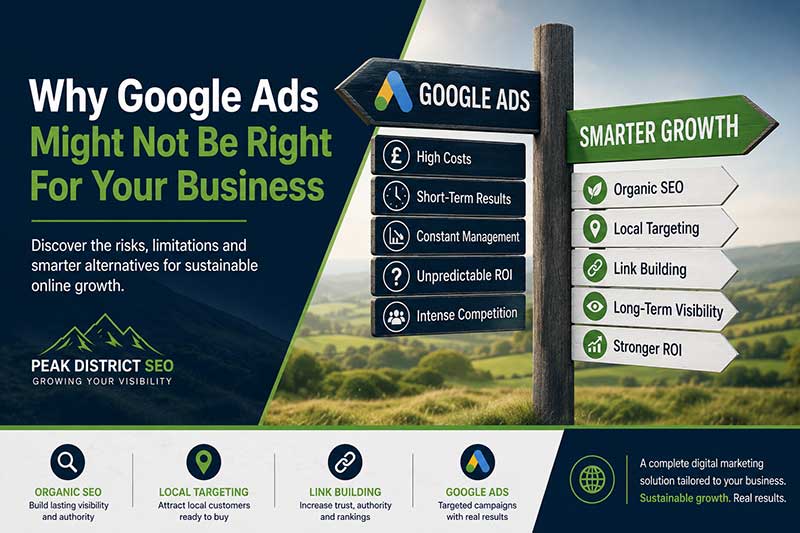
At Peak District SEO, we regularly speak to small business owners who have spent thousands on Pay Per Click advertising, commonly shortened to PPC, with very little to show for it. PPC simply means businesses pay each time somebody clicks on their advert. We run Google Ads for lots of our customers, but there are some websites and indeed some businesses that just aren’t ready for Google Ads. Poor Google Ads performance is more common than many advertisers realise. Expensive clicks, weak advert wording, poor landing pages and incorrect campaign settings can quickly lead to wasted spend.
That is why businesses need a strategic approach before investing heavily into paid advertising campaigns.
As a specialist SEO and digital marketing agency, Peak District SEO helps businesses grow their visibility through a range of marketing techniques from Organic SEO, Local Targeting, Google Ads and Link Building. In many situations, combining multiple digital marketing strategies delivers better long-term profitability than relying solely on paid search advertising.
What Are Google Ads?
Google Ads, formerly known as Google AdWords, is Google’s online advertising platform. Businesses bid on search terms so their adverts appear within Google’s search results and across the Google Display Network, which is Google’s large network of websites and apps that display adverts.
When users search for relevant keywords, advertisers compete for visibility through different bidding strategies.
For example:
- Manual CPC allows businesses to manually choose how much they are willing to pay each time somebody clicks their advert. CPC stands for Cost Per Click.
- Target CPA, which means Target Cost Per Acquisition, allows Google to automatically adjust advert bids in an attempt to generate leads or sales at a chosen average cost.
- Target ROAS stands for Target Return On Ad Spend. This strategy attempts to generate a certain amount of revenue based on the amount being spent on advertising.
Google Ads campaigns can include:
- Search ads that appear in Google search results
- Display ads shown across websites and apps
- Shopping campaigns for ecommerce products
- Performance Max campaigns, which are automated campaigns that run across multiple Google platforms at once
- Video advertising on YouTube
- Mobile phone advertising
- Local service campaigns
The main attraction is instant results. Unlike Search Engine Optimisation, often shortened to SEO, which can take time to build momentum naturally, paid ads can drive traffic immediately.
But instant traffic does not always mean real business growth.
The Benefits of Google Ads
There are genuine benefits to the Google Ads platform when campaigns are managed correctly.
A profitable Google Ads campaign can:
- Generate qualified leads quickly
- Increase brand awareness, meaning more people become familiar with your business
- Deliver measurable results
- Reach ideal customers
- Target specific search terms
- Improve advert visibility
- Support performance marketing goals
- Help businesses enter a competitive market
Google Analytics and Google Ads conversion tracking also provide valuable insights into customer behaviour.
Conversion tracking simply means monitoring which adverts lead to enquiries, phone calls, purchases or other important business actions.
These systems can also help businesses understand:
- Which pages users visit
- How long visitors stay on the website
- Which adverts generate leads
- Which keywords produce sales
- Where users leave the website
This information helps businesses make better data-driven decisions, meaning decisions based on real information rather than guesswork.
For some industries, Google Ads remains extremely effective. However, there are also major limitations.
Why Google Ads Might Not Work For Your Business
Many businesses assume Google Ads guarantees success. Unfortunately, that is not how paid search works.
High Competition Creates Higher Costs
One of the biggest reasons businesses struggle with Google Ads is high competition.
Industries such as legal services, real estate, finance and healthcare often experience extremely expensive clicks because many businesses compete for the same search terms.
The average cost per click can quickly destroy a small budget before any meaningful leads are generated.
Some advertisers spend hundreds or even thousands each month attracting the wrong visitors who never intended to buy.
Without careful keyword research and negative keyword lists, businesses can attract irrelevant traffic.
Negative keywords are words or phrases that prevent adverts from appearing for unsuitable searches. For example, a premium service provider may want to exclude searches containing words like “cheap” or “free”.
This helps reduce wasted spend and improve campaign profitability.
Poor Conversion Tracking Leads To Bad Decisions
Google Ads conversion tracking is essential.
Without accurate conversion tracking, businesses cannot properly understand which campaigns generate real results. Many advertisers only track website forms while ignoring offline conversions such as phone calls or in-store enquiries.
Offline conversions simply refer to enquiries or sales that happen away from the website itself.
At Peak District SEO, we often discover businesses running PPC management campaigns blindly without understanding their true conversion rate.
A conversion rate measures the percentage of website visitors who become customers or enquiries.
Businesses also need to understand their target cost, meaning how much they can afford to spend in order to gain a new customer profitably.
Without this knowledge, businesses often continue spending money on campaigns that are losing money.
Weak Landing Pages Hurt Campaign Performance
Even if adverts generate traffic, poor landing page experience can damage campaign performance.
A landing page is the page users arrive on after clicking an advert.
Common issues include:
- Slow loading times
- Poor user experience
- Weak calls to action
- Generic home page targeting
- Poor Web Design
- Low landing page relevance
- Mobile phone usability problems
However, one major issue many businesses overlook is the website platform itself. The platform a website is built on can directly affect how well Google Ads tracking works.
For example, websites built using Google Sites often have serious limitations when it comes to advanced conversion tracking and analytics setup. This can make it difficult for businesses to accurately monitor leads, phone calls and customer behaviour.
Low-cost website builders and free website platforms can also create problems. While these systems may appear affordable initially, they sometimes restrict access to important settings needed for proper tracking code installation and campaign optimisation.
Many businesses also use external booking systems or third-party quote forms. These systems can interrupt the customer journey and prevent conversions from being tracked correctly. In some cases, businesses may believe adverts are underperforming when leads are actually being lost within disconnected tracking systems.
Bespoke website builders and heavily customised templates can create similar problems. Developers sometimes forget to correctly install tracking codes across every page or form submission process. This can result in inaccurate reporting and misleading campaign data.
At Peak District SEO, we are also seeing an increase in fully AI-built websites. While AI website builders can speed up website creation, many lack proper content management systems and advanced admin controls.
A content management system, often called a CMS, is the software used to manage website settings, pages and tracking tools.
Without proper CMS functionality, businesses may struggle to:
- Install tracking codes
- Verify conversion tracking
- Connect Google Analytics properly
- Configure advertising pixels
- Track phone calls accurately
- Monitor customer behaviour effectively
This creates major visibility problems inside Google Ads.
A call to action is a prompt encouraging visitors to take action, such as requesting a quote or making contact.
Google closely evaluates user behaviour. If visitors leave quickly, advert quality scores can decline, increasing advertising costs even further.
Dedicated landing pages are often required for better results. These are pages specifically designed around one product, service or advert campaign.
At Peak District SEO, we regularly help businesses diagnose tracking problems caused by outdated websites, restrictive platforms and poorly configured website systems before valuable advertising budget is wasted.
Google Ads Are Not Always Ideal For Small Businesses
Small business owners with limited marketing budgets often struggle with PPC advertising.
A small daily budget may not generate enough clicks to properly optimise campaigns. In highly competitive industries, Google Ads can become a constant drain on marketing spend.
This is especially true for:
- New business websites
- Small local businesses
- Niche service providers
- Businesses without a strong online presence
- Companies with weak sales processes
In today’s digital world, businesses need more than paid search advertising alone.
Why SEO Often Delivers Better Long Term Results
Organic SEO creates sustainable visibility.
SEO means improving your website naturally so it appears higher within search results without paying for every click.
Unlike paid ads, strong organic rankings continue generating opportunities without ongoing advertising costs.
SEO also supports visibility inside modern AI search systems such as:
- ChatGPT
- Gemini
- Perplexity
- Claude by Anthropic
Large Language Models, often shortened to LLMs, increasingly reference authoritative websites with strong Experience, Expertise, Authoritativeness and Trustworthiness signals, commonly known as EEAT.
At Peak District SEO, we focus on creating content strategies that improve both traditional Google rankings and AI-driven search visibility.
This includes:
- Search Engine Optimisation
- Link Building, meaning gaining links from other trusted websites
- Local Targeting
- Content optimisation
- Technical SEO
- Google Business Profile optimisation
- Keyword research
- Authority building
These techniques support real business growth rather than temporary traffic spikes.
Alternatives To Google Ads
For some businesses, alternative digital marketing strategies may deliver lower-cost customer acquisition.
Customer acquisition simply means gaining new customers.
Organic SEO
SEO helps businesses rank naturally within Google’s search results over time. Strong SEO improves trust, authority and online presence.
Social Media Advertising
Social media advertising platforms such as Facebook Ads allow businesses to build brand awareness while targeting audiences based on interests, demographics and behaviours.
Unlike search ads, social advertising can influence the purchasing decision earlier in the customer journey.
The customer journey refers to the steps a person takes before deciding to buy a product or service.
Email Marketing
Email marketing remains one of the most cost-effective digital marketing methods available.
Businesses can nurture existing clients and encourage repeat purchases without paying for every click.
Local SEO
Local Targeting helps businesses dominate nearby search traffic through maps visibility, local citations and regional content.
This is particularly effective for trades, home services and local service businesses.
How To Improve Google Ads Performance
Google Ads can still work exceptionally well when managed correctly.
Businesses should focus on:
- Clear campaign goals
- Proper conversion tracking
- Smart keyword lists
- Relevant keywords
- Specific keywords
- Negative keyword lists
- Compelling advert wording
- Better landing page experience
- Accurate audience targeting
- Ongoing campaign management
- Monitoring search terms regularly
- Using Keyword Planner effectively
- Testing different bidding strategies
Keyword Planner is a Google tool that helps businesses discover search terms and estimate traffic levels and advertising costs.
Peak District SEO manages Google Ads Services alongside SEO campaigns, so businesses achieve balanced long-term growth rather than relying entirely on paid advertising.
The Importance Of Understanding Your Target Audience
Before launching a brand new campaign, businesses must understand:
- Their target audience
- Customer intent
- Search behaviour
- Device usage
- Purchasing decision process
- Conversion barriers
- Competitive market conditions
Customer intent refers to the reason somebody searches online in the first place.
For example, somebody searching “best emergency plumber near me” is usually much closer to making contact than somebody searching “how plumbing systems work”.
Without understanding customer behaviour properly, even well-designed campaigns may fail to produce results.
Every business is different. Some companies benefit heavily from paid search. Others achieve far stronger Return On Investment, often shortened to ROI, through SEO, Local Targeting and Link Building.
ROI simply measures how much profit a business generates compared to how much it spends.
That is why a clear strategy matters.
Why Businesses Trust Peak District SEO
Peak District SEO works with businesses across a wide range of industries. We understand that no two marketing campaigns are identical.
Our team focuses on:
- Honest marketing advice
- Transparent reporting
- Data-driven decisions
- Realistic growth strategies
- Long-term online visibility
- Sustainable lead generation
- Conversion-focused campaigns
Rather than simply increasing advertising spend, we identify the root cause of poor performance and recommend the right strategy for each business.
Sometimes Google Ads are the answer.
Sometimes they are not.
FAQs
What are the potential downsides of Google Ads?
Google Ads can become expensive very quickly. Businesses may experience expensive clicks, wasted spend, poor conversion rates and irrelevant traffic if campaigns are poorly managed.
Can Google Ads work without conversion tracking?
Yes, Google Ads can still generate clicks, enquiries and sales without proper conversion tracking. However, this makes the campaign much higher risk.
Conversion tracking shows which adverts, keywords and searches are producing real enquiries or sales. Without it, a business may know that money is being spent, but it cannot accurately judge which parts of the campaign are working.
This can lead to wasted spend, poor decisions and missed opportunities. Proper tracking gives businesses the evidence they need to improve performance and reduce risk.
Are Google Ads better than SEO?
Not always. Google Ads can generate instant traffic, but SEO often delivers stronger long-term value, especially for businesses wanting sustainable visibility and lower customer acquisition costs.
Why do many small businesses struggle with Google Ads?
Small business owners often have limited budgets, high competition and poor campaign structure. Without strategic campaign management, advertising campaigns may fail to generate profitable leads.
Can social media advertising be more effective than Google Ads?
In some industries, yes. Social media advertising helps businesses build brand awareness and influence customer behaviour earlier in the buying process.
Does Peak District SEO offer alternatives to Google Ads?
Yes. Peak District SEO provides Organic SEO, Local Targeting, Link Building, technical SEO, content optimisation and Google Ads management depending on business goals.
Ready To Build Sustainable Online Visibility?
If your Google Ads account is underperforming, or you are unsure whether paid advertising is the right fit for your business, Peak District SEO can help.
We create tailored marketing strategies focused on real growth, qualified leads and long-term visibility through Organic SEO, Local Targeting, Google Ads and Link Building.
Visit the Peak District SEO contact page today and speak with our team about building a marketing strategy that actually works for your business.
You may also like:
- How Can Google Ads Help You Advance Your Business Goals?
- Case Study – Massive Google Ads Success for Motorhomes Dealership
- Google Ads Company Near Me

I’m Phil Gregory, the MD and founder of Peak District SEO.
I’m an SEO & Google Ads Consultant with 28+ years of experience in I.T and helping UK Businesses improve website performance.
I built my first website in 1998, then I discovered the joys of website optimisation and never looked back.
If you want a no-nonsense, no-hard-sell approach and to actually get your website fixed with a solid, affordable, long-term approach, hit the contact button today.
Peak District SEO is a UK-based Digital Marketing Company.
We help businesses make more money, using traditional Search Engine Optimisation (SEO) , Ai Search / GEO and paid advertising (PPC).
Why Peak District SEO?
27+ years of experience.
80+ 5* reviews on Google
Our customers have hundreds of page one and position 1 rankings, and we can prove it.
We’ve helped hundreds of SMEs in the UK
We have numerous articles published across the web discussing SEO.
We regularly publish case studies about the work we’ve done
Customers trust our service – See our reviews on Google, Trustpilot and Facebook
Our customers have hundreds of page one and position 1 rankings and we can prove it.