SEO tools can produce an extraordinary amount of data. The difficult part is working out which figures actually matter.
At Peak District SEO, we believe SERP metrics should help businesses understand what is happening in the search results, why their website is gaining or losing visibility, and what should be done next. We have a great solution for helping businesses focus on what ranks their websites, rather than overwhelming them with reports containing numbers that never lead to meaningful action.
SERP stands for Search Engine Results Page. SERP metrics are measurements used to assess how a website, page or group of keywords performs within Google search results and other search engines.
Useful SERP metrics include keyword rankings, website visibility, average position, click-through rates, organic traffic, search volume, SERP features, Featured Snippets, AI Overviews and competitor performance.
Used correctly, these SEO metrics provide something far more useful than a simple ranking report. They help us understand the complete search landscape around a business.
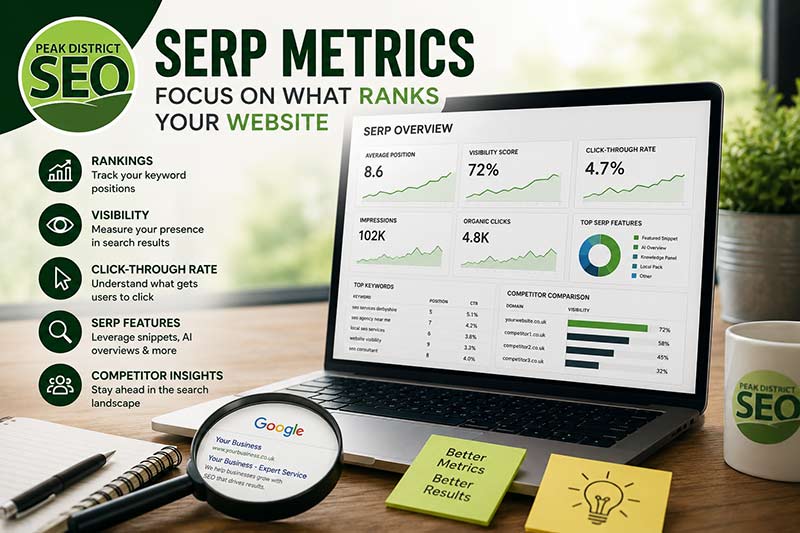
Why SERP Metrics Matter for SEO
There was a time when SEO performance could largely be discussed in terms of where a website ranked for a handful of keywords.
Position one was good. Position ten was less impressive. Modern Google search results are considerably more complicated.
A user’s search query might produce paid ads, Shopping Results, organic search results, a knowledge panel, Google Images, video content, Top Stories, local results, Featured Snippets, rich results and Google AI Overviews.
That means simply saying “we rank number four” does not necessarily tell us how visible a business really is.
The ranking position still matters, but it needs context.
At Peak District SEO, our Search Engine Optimisation work looks at SERP rankings alongside website traffic, search intent, user behaviour, competitor analysis and actual business performance.
The objective is not collecting SEO metrics for the sake of having more data.
The objective is making data-driven decisions that improve website visibility and attract potential customers.
Which SERP Metrics Should You Actually Track?
There is a broad range of SERP metrics available, but some provide considerably more useful information than others.
Keyword Rankings
Keyword rankings measure a website’s position for a target keyword or group of tracked keywords.
A rank tracker or SERP checker tool can monitor these positions on a daily basis, creating historical data that shows how rankings have changed.
This can reveal important trends.
For example, if ten important service pages gradually move from positions 15 to 6, the SEO efforts being applied are clearly producing movement, even though those pages may not yet occupy the first organic result.
At Peak District SEO, we are particularly interested in groups of relevant keywords rather than obsessing over one isolated search query. One keyword can fluctuate. A keyword group provides a much more comprehensive view of SEO performance.
Search Visibility
A visibility score estimates how prominently a website appears across a collection of search results.
This can be particularly useful when tracking hundreds or thousands of keywords.
Google visibility score data and visibility measurements provided by SEO platforms can help identify wider changes that might not immediately be obvious from individual keyword rankings.
If website visibility rises across multiple keywords and pages, it can indicate that the overall SEO strategy is gaining traction. Likewise, a sudden visibility decline deserves investigation.
Organic Traffic and Traffic Potential
Rankings become considerably more interesting when they produce website traffic.
A keyword might have impressive search volume, but that does not automatically make it commercially valuable.
We need to consider traffic potential, user intent and search intent.
An informational query may attract thousands of searches but generate very few enquiries. A highly specific local search might have much lower search volume but produce targeted traffic from people actively looking for a service.
That distinction matters.
Peak District SEO uses platforms including Google Search Console and Google Analytics to understand what happens beyond the ranking itself.
Google Search Console can show queries, impressions, clicks and average position. Google Analytics can then help us understand what users do when they reach the website. Together, these SEO metrics provide a much better picture of SEO performance.
Click-Through Rates
Click-through rate, usually shortened to CTR, measures how frequently somebody clicks a search result after seeing it.
Imagine your website appears 1,000 times and receives 80 clicks. Its click-through rate would be 8%.
CTR can be influenced by various factors, including:
- website’s position
- title tags
- meta descriptions
- brand awareness
- user intent
- rich results
- Featured Snippets
- competing paid ads
- SERP features
- relevance to the user’s search query
This is why Peak District SEO pays attention to title tags and meta descriptions as part of Search Engine Optimisation.
Reaching the first page is important, but the search result also needs to persuade somebody to click it.
SERP Features Have Changed What “Ranking” Means
Traditional organic listings, sometimes called blue links, now compete with an increasing number of search features.
These include Featured Snippets, knowledge panels, Shopping Results, product listings, Top Stories, Google Images, local results, video content and AI Overviews.
The SERP itself therefore needs to be analysed.
For example, a search dominated by visual content might suggest that creating strong images or video content would improve online visibility.
A current SERP containing mainly service pages suggests something different.
If informational blog posts dominate, Google may be interpreting the search intent as informational rather than transactional.
This is where SERP analysis becomes particularly valuable.
Rather than asking only: “Where do we rank?”
We ask:
“What is Google choosing to rank for this search query, and why?”
That is a much more useful SEO question.
Google AI Overviews and Modern SERP Monitoring
Artificial intelligence and machine learning are changing the appearance of Google search results.
Google AI Overviews can provide AI-generated summaries directly within the results. This creates another visibility opportunity, but it also means traditional keyword rankings cannot tell the entire story.
SERP monitoring increasingly needs to identify whether AI Overviews are appearing, which sources are being referenced and how traditional organic listings are positioned around them.
This is also relevant beyond Google.
Businesses increasingly want their expertise and content to be discoverable through systems such as ChatGPT, Gemini, Perplexity and Claude.
There is no single metric that guarantees visibility within an LLM. However, the same fundamentals remain valuable: clear subject expertise, relevant content, accurate information, strong brand signals, useful service pages and content that answers real questions comprehensively.
SERP Metrics and Local SEO
SERP metrics become even more complicated for a local business. Local searches can produce different Google results depending on the searcher’s location.
A company might rank extremely well from one location and considerably lower from another. This is why SERP monitoring across different locations can be important for Local SEO.
We also need to consider the Google Business Profile, positive reviews, local keywords, local organic rankings and the presence of map-based search features.
For a business serving several towns or cities, checking one location provides only part of the picture.
Peak District SEO therefore considers the geographical context behind local keyword rankings rather than treating every search as though everybody in Britain receives identical Google search results.
How Competitor Analysis Improves SERP Performance
Your own SERP metrics tell you what your website is doing.
Competitor analysis can help explain why.
If competitors consistently outrank your website for relevant keywords, we can examine the top-ranking pages and look for patterns.
- Do they provide more useful content?
- Is their content quality better?
- Do they answer the search intent more directly?
- Do they have stronger high-quality backlinks?
- Are they using schema markup effectively?
- Do their pages load faster?
- Have they created dedicated service pages, product pages or location pages?
- Are new competitors entering the current SERP?
This analysis can reveal opportunities for new keywords, fresh content and improvements to existing pages.
The aim should not be to copy competitors. It should be to understand what the search results are telling us and then create something genuinely more useful.
Content Quality Is a SERP Metric You Cannot Reduce to One Number
SEO software loves scores.
Domain authority, ranking difficulty, content scores and visibility scores can all be useful indicators, but no third-party number should replace human judgement.
Google wants to provide relevant content that satisfies the search query. That means content quality remains central to successful Search Engine Optimisation.
- A useful product page should help somebody understand and evaluate the product.
- A strong service page should explain the service, establish expertise and help potential customers decide whether the business is suitable.
- A blog post should properly answer the question it targets.
At Peak District SEO, we would rather create relevant content for genuine users than chase an arbitrary score produced by an SEO tool.
Core Web Vitals, Page Speed and User Experience
SERP metrics should also be considered alongside technical SEO metrics.
Core Web Vitals, page speed and mobile optimisation can influence the browsing experience.
A seamless browsing experience makes it easier for visitors to interact with a website once they arrive.
Technical improvements can therefore support a wider digital strategy.
However, context remains important.
Making an already fast page 0.1 seconds faster may be less valuable than fixing a page that does not adequately answer its target search intent.
This is another reason why SEO requires informed decisions rather than blindly chasing scores.
Turning SERP Data Into SEO Decisions
The most important stage is converting SERP metrics into action.
Suppose a page has a high average position but disappointing click-through rates. We might investigate its title tags and descriptions.
- If a page ranks between positions 11 and 20 for multiple keywords, improving its relevant content, internal linking and backlinks might move it onto page one.
- If impressions are rising but website traffic is not, we need to investigate why.
- If a competitor suddenly gains website visibility, competitor analysis may reveal new content types or search features appearing within the current SERP.
- If Featured Snippets repeatedly appear for a keyword group, restructuring content to provide concise answers could create another route to online visibility.
This is what SERP metrics should ultimately provide: informed decisions.
Don’t Confuse SEO Metrics With Business Results
There is another point that we think deserves considerably more attention.
- Rankings are not revenue.
- Traffic is not necessarily enquiries.
- A visibility score does not pay an invoice.
- A website can have excellent-looking SEO metrics while producing surprisingly little commercial value.
- Peak District SEO therefore looks beyond surface-level numbers.
- If organic traffic is increasing, is it relevant traffic?
- If keyword rankings have improved, are they commercially relevant keywords?
- If website traffic has doubled, have enquiries and sales increased too?
- SEO performance needs to be connected to business objectives wherever possible.
That is how businesses avoid spending months celebrating graphs while wondering why the telephone is not ringing.
SERP Metrics Are an Ongoing Process
Search results constantly change.
Google’s algorithms evolve, competitors publish fresh content, new competitors appear, user behaviour changes and search features develop.
SERP monitoring therefore needs to be an ongoing process.
Daily Tracking may be appropriate for important keyword groups, although individual day-to-day fluctuations should not automatically cause concern.
Historical data is generally much more revealing.
Look at trends.
Compare months and quarters. Examine groups of keywords. Review website visibility alongside organic traffic and conversions.
That provides a much clearer picture of whether an overall SEO strategy is actually working.
Frequently Asked Questions About SERP Metrics
What role do SERP metrics play in measuring SEO success?
SERP metrics help measure website visibility, keyword rankings, click-through rates, average position and performance across different search features. They allow an SEO Specialist to identify trends and determine whether SEO efforts are producing meaningful improvements.
What is a visibility score in SEO?
A visibility score estimates how prominently a website appears across a tracked group of search queries. Rather than concentrating on one keyword, it provides a broader indication of organic visibility and can be useful when measuring changes in an overall SEO strategy.
Do higher SERP rankings always produce more website traffic?
Not necessarily. SERP rankings influence traffic potential, but search volume, search intent, paid results, AI Overviews, Featured Snippets and other SERP features can all affect click-through rates. The relevance of the keyword also matters enormously.
What is a SERP checker tool?
A SERP checker tool monitors where websites appear within search engine results for selected keywords. More advanced tools can provide historical data, Daily Tracking, different locations, competitor analysis and monitoring of search features. We use high-end paid software that costs well over £1000 per month
How can SERP data improve an SEO strategy?
SERP data can identify declining keyword rankings, new keywords, competitor gains, Featured Snippet opportunities and pages that are close to reaching stronger organic rankings. This information allows SEO work to be prioritised according to evidence rather than guesswork.
Are AI Overviews important when tracking SERP metrics?
Yes. AI Overviews are becoming part of the modern search landscape. They can alter how much space traditional organic search results occupy and how users interact with Google results. Modern SERP analysis should therefore consider AI-generated summaries alongside conventional organic rankings.
Should businesses track SERP metrics every day?
Daily Tracking can be useful for competitive keywords, but daily fluctuations should be treated cautiously. Historical data and longer-term trends normally provide a better indication of whether an SEO strategy is succeeding. Monthly tracking and year on year (YOY) is more reliable
Focus on the SERP Metrics That Actually Matter
There are hundreds of SEO metrics that can be measured.
You probably don’t need most of them.
At Peak District SEO, our approach is to concentrate on information that helps explain how websites perform in organic search and, more importantly, what can be done to improve that performance.
SERP rankings, visibility, click-through rates, organic traffic, competitor movements, search intent and conversions can provide an exceptionally useful picture when they are analysed together.
The trick is knowing what deserves your attention.
That is where experienced Search Engine Optimisation becomes considerably more valuable than simply buying another piece of reporting software.
Want to Know What Is Really Affecting Your Google Rankings?
If you’re surrounded by SEO reports but still aren’t sure what actually ranks your website, Peak District SEO can help turn SERP metrics into a practical SEO strategy.
We analyse your Google search results, keyword rankings, competitors, website visibility and organic performance to identify where the genuine opportunities lie.
Contact Peak District SEO to discuss your website and find out where your SEO efforts should be focused next.
You may also like:
- What Are Serp Features & How To Rank For Them
- Google Ranking Factors: What Actually Helps Websites Rank on Google in 2026?
- What Does SERPs Stand For? Understanding Search Engine Results Pages

I’m Phil Gregory, the MD and founder of Peak District SEO.
I’m an SEO & Google Ads Consultant with 28+ years of experience in I.T and helping UK Businesses improve website performance.
I built my first website in 1998, then I discovered the joys of website optimisation and never looked back.
If you want a no-nonsense, no-hard-sell approach and to actually get your website fixed with a solid, affordable, long-term approach, hit the contact button today.
Peak District SEO is a UK-based Digital Marketing Company.
We help businesses make more money, using traditional Search Engine Optimisation (SEO) , Ai Search / GEO and paid advertising (PPC).
Why Peak District SEO?
28+ years of experience.
80+ 5* reviews on Google
Our customers have hundreds of page one and position 1 rankings, and we can prove it.
We’ve helped hundreds of SMEs in the UK
We have numerous articles published across the web discussing SEO.
We regularly publish case studies about the work we’ve done
Customers trust our service – See our reviews on Google, Trustpilot and Facebook
Our customers have hundreds of page one and position 1 rankings and we can prove it.