This article is a follow-up to a presentation given by Phil Gregory at Business Hub Club Networking at Aldern House, Bakewell, Derbyshire, on the 15th of April 2026.
The aim of the talk was to help business owners navigate the many potential pitfalls when dealing with web hosts, web developers, and marketers. This guide will give you some key info for things to look out for that could potentially harm the future growth of your site. Implementing these steps will help you to avoid these pitfalls and then have to unpick them at a later date. * All the points raised are Phil’s opinion based on his 27years+ experience in the web sector.
Domain Names – Things to look for
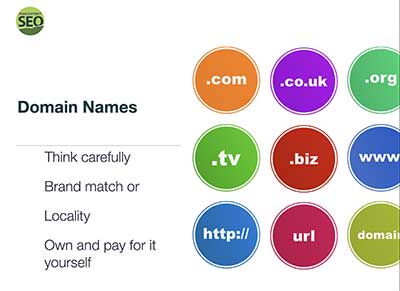
When it comes down to domain names, there are obviously lots of domain name extensions for top-level domains. Dot com and dot co dot UK are the best suffixes that you can choose as a UK business. They still represent companies. Eg: .com and .co.uk
.org is best for a charity, .ac .uk or .edu for any educational facility, and I would still, even in 2026, recommend that you stick with these old-fashioned, basic suffixes.
Sure, there are lots of new suffixes available, but at the same time, many customers are not familiar with the new suffixes and have problems typing them into Google, remembering them, or even understanding them.
Be sure to make sure that you own the domain yourself and pay for it yourself with your credit card, if possible. You can get your web host or web designer to do it, but make sure that they invoice you for the service because I have seen instances where web hosts or web developers have bought domain names for clients and then kept the domain name themselves, never invoicing the client. When the client later decides, “Hey, I want to move to a different web developer or a different web host“, they have been told in no uncertain terms “the domain belongs to us, you cannot move because we own the domain name“, and they are stuck.
So mitigate against that and make sure that you pay for the domain and own it yourself.
Web Hosting – Things to look for
Reliability
Reliability with hosting is obviously critical. You want to be looking for at least 99% uptime on your server. But if we’re being truly honest, almost every web host out there is going to offer you 99% uptime. Even if they cannot deliver it, they are going to tell you that they will deliver it. So that’s just one thing to look out for. There are many other things.
Server Speed
Speed is important. Speed is going to allow your user experience to be better for your customers. If the website loads quickly, they are not waiting around. If it functions quickly, as soon as the customer gets on the page, they can start interacting with the page. It’s going to do your SEO and your conversion rate some benefit. People do not like waiting for pages to load, and they like being able to interact with the website quite quickly. Google will check the speed of your website, how it loads on a computer, and how it loads on a mobile device. If those metrics have a low score, then you might suffer some level of penalty in terms of your Google rankings.
Hosting Support
When you pay for web hosting, you need reasonably good support. Quick and reliable is the metric that I look for. I want to be able to go to the hosting website and say, “Where’s the phone number?” Find the phone number, call them, and speak to a human being. I do not want to get locked into an automated chatbot. I want a human being who will speak to me and can understand the problem I am facing. I think that’s really critical, and that you are not going to be waiting for hours to get support.
If your website has gone down and it makes you several thousand pounds a day, your website needs urgent support. You need to have a ticket that gets through to support very quickly. And that support, again, needs to be reliable. They need to tell you what the issue is, that they can see the issue, that they are dealing with it, and give you a timeframe for fixing it.
Website Security
Any good hosting package needs to offer SSL certificates, hopefully not a paid one, but preferably something like Let’s Encrypt. They should purchase the certificate, put it in place, implement it, and be in charge of renewing it every year when it expires.
A good hosting company will offer you a firewall and malware protection on your hosting package. It’s important that you have a login panel for your hosting, so that you can go to a specific page, log into your hosting panel, create email addresses, delete files on your website, and so on.
If your web host does not allow you to do this, there is a strong possibility that they are hosting your website inside one folder with many other websites, which is a huge security risk. Also, if the hosting company gives you any pushback when you ask for this kind of access, it’s a big red flag, and I would urge you to look for alternative accommodation.
SEO and Google Ads – Things to look for
When it comes down to digital marketing your website, you are going to have to set aside a budget, a budget for SEO or Google Ads, or possibly both. A good SEO company will cost you between £300 and £2000 a month.
Your Google Ads will cost you at least £300 a month to start, using a budget of around £10 a day for the very basic campaigns. Anything less than that is unlikely to gather much traction.
You may want to use social media marketing. There are two types of social media marketing that you can employ:
- Organic social media marketing, which is just making posts on your page or your personal profile
- Paid social media marketing, where you create ads inside an ad system on platforms such as Meta, X, Pinterest, or LinkedIn, and then you pay to boost these posts to specific audiences
It’s a similar type of PPC that Google Ads uses. Again, that would be a separate budget, so if you already have SEO and Google Ads, paid social media marketing is an additional cost. You can mitigate this cost by using organic social media marketing to support the work you are doing with organic SEO and Google Ads.
Off-Site Marketing – Things to look for
Off-site marketing is basically employing and gathering backlinks from other sites to link to your site. An SEO company will help you to find quality sites that will link to yours, boosting the credibility of your website. Also, they will help you to get multiple directory listings which, whilst diminishing in value in the late 2020s, still carry some kudos to pass endorsement to your website. And every mention of your website across the web increases the chance of you getting more clicks.

Offline Marketing
Something that so many customers fail to act upon. Do you have business cards? Do you have flyers or merchandise that you can give to your customers? Do you have branded workwear? If you have a vehicle that you use for your business, is it fully liveried with your logo, phone number, and social media links? It needs to be. Perhaps you could sponsor an event, a local roundabout, a local football stadium, or team. All of this is offline marketing and can still help to raise your visibility in the local area.
Ads Audits and Quotes
If you are going to hire an SEO company, you will need to have an audit, an audit of your website. If an SEO company gives you a quote without an audit, that should raise an alarm bell. It just means you are a number in their list because they have not analysed your website to find out exactly what is wrong with it before they quote for the work.
An audit will analyse how your website performs in terms of its technical structure, how it’s built, the templates, the code, the images, any videos, and the content on the site. It will give it a score that can be used as a benchmark for improving the performance of the website, which may mean liaising with your web developer and host to make sure that the site meets a basic common standard. Only then can your SEO company give you an accurate quote for the work that they will carry out to improve your project.
Set Your Goals
When you speak with your SEO company, ensure that you set goals. What is it that you want to achieve with your business? What do you want the website to do? Is it to create sales of products? Is it to gather phone calls or form submissions? Or is it just to raise your visibility? These goals of yours really matter because they will allow the SEO company to build a strategy that will work in line with your timescales and your budget. Without this, they are shooting blind. Once you have a strategy, begin to apply it.
Once the points on the strategy have been applied, we measure them on a monthly basis to see how the points are performing. If they are performing well, we take note and continue that strategy. If they are not performing as well as hoped, we would refine the strategy slightly until they are. Then you rinse and repeat.
Use Data for Decisions
It’s really important that you use data to make decisions about your website. Do not use your gut. Do not put your amateur designer head on and make sweeping changes without discussing it with both your web developers and your SEO partner. Random, off-the-cuff changes can crash websites and knock them right off Google.
Audits – What a Website Audit Will Show You
What is a website audit and what will you find out from it? Well, the reality is that you will find out the state your website is in. It could be that your website is absolutely brilliant and has been built perfectly with SEO in mind and web accessibility in mind. It loads fast, it looks good, it converts well. And if that’s the case, I’m the happiest man for you.
However, based on my experience of most clients who come to me needing SEO and marketing, their website is not in a good state. It’s been built through design, usually just to look good, and little thought has been put into the functionality of it, and there is no maintenance package in place to fix things like technical SEO errors.
SEO errors really can be broken down into three categories:
- Errors
- Warnings
- Notices
Paid SEO software, such as SEMrush, will always break issues down into these chunks. Errors are critical and things that you really need to get fixed. Warnings will affect your SEO, but are not quite as urgent. Notices are simply things that are nice to have in terms of building a more perfect website. They are not critical, but they definitely will help you, especially if the number of issues flagged as a notice is high.
Moreover, a website audit will give you a realistic perspective on the timescale that it will take to fix your website.
Speed and Usability
When you are having a website built, speed and usability are something that you are going to have to look for. I would urge you to hold your web developer’s feet to the fire on this. The website has to be fast. That means the hosting has to be fast and the website has to be built correctly. It has to pass Core Web Vitals, Google’s core web vital scores. It has to be built in a mobile-friendly way, pass mobile-friendly checks, and pass desktop speed checks.
It needs to have a good layout that brings the customer in, tells them who you are and what you do, lays out your offer, and brings them to a call to action, such as click this button to call us, click this button to download our fact sheet, or click here to contact us. Without those calls to action, traffic on your website can become lost or confused and simply leave. Make it quick, fast, easy to understand, and have a point.
Ranking Is Only Part of SEO
Ranking is only part of the picture with your website. If you want your website to feature highly on the search engines, there are some key elements that you must include throughout the website. Just looking good and having a well-known brand does not mean you will rank. If you are a small company, your brand will not be well-known. And just having a slick-looking website will serve no purpose whatsoever.
So the first key thing that I would ask you to focus on relentlessly when planning the copy for your website is relevance. Make sure that the words on the page, the images on the page, and the videos on the page are relevant to your name, your niche, your local area, and the general topic overall. Without that relevance, you will not have a chance to show up when people search for goods and services in your niche.
To have that relevance supported and recognised, you will have to build authority. Authority basically means that you are seen as someone who is highly knowledgeable, someone or a company who is highly knowledgeable, in your area of expertise. It’s no good just saying, hi, I’m Dave Smith, I’m an expert in this, because that’s just a statement.
What you have to do is qualify that statement, like this:
“Hi, I’m Dave Smith,
I’m an expert in _____,
I’ve been doing it for 20 years.
Here are my certificates to prove that I’m qualified.
Here is a list of reviews of people who say how good I am at doing the job.
Here are some case studies that demonstrate the success I’ve had with my clients. Here are some trust signals, such as key selling points, payment features”,
..and so on.
All of these elements help to build your authority, leading to customer trust. There are others, but those are the core things that you have to speak to. Try to answer questions that your customers might ask. Building an FAQ section on your website is highly common in this day and age, but honestly, if you can build an FAQ section on every service page, you will still do a lot better because you are really offering unique answers to people’s real problems.
Content Creation
The cliché is “content is king,” and nothing has ever been truer. Your website should contain copy. I’ve seen hundreds of websites over the years that contain nothing but slick images and perhaps a JavaScript slideshow and a call-to-action button. Well, those sorts of websites rarely convert unless you are a huge brand like McDonald’s or Costa Coffee.
If you are a small company, the chances are you are going to have to take a little bit more effort to convince your potential customers to trust you and to go further investigating your website, your offering, and your services. How do we do that? We do it with copy.
And copy must be full of the correct keywords. Keywords are just words that are related to what it is you do, your service, your local area, your expertise, and the questions people ask. So, all the copy on your website must encompass those ideas.
Try to use images that reflect your business, not just stock images, although they are useful. Try to have some real images taken by a professional photographer that show you and your team in the midst of solving problems for your customers. Those sorts of things really resonate with the local audience and help to show that you are a real business and not just a company using stock images. The same goes for videos.
Once you have got these fantastic resources, such as headshots and real live-action footage, whether it be photography or videography, you can reuse all of that in your blog articles and on your social media profiles.
Blogs and Regional Authority
Talking of blogs, A blog is a great way for you to expand your regional authority. You may be a garage in Matlock, so your website may say;
“Welcome to Matlock Garage. We fix cars.”
That’s not going to be enough for some people. Most people will have a more specific problem, eg, they need a remap, or they have a suspension issue, or they need bodywork done.
If you offer these services, it’s no good to just say that you are a garage and leave it at that. You will need to say, “We offer bodywork.” And then you can do better by having a bodywork page that talks about the types of issues you’ve fixed before, what you’re good at, and what you do and do not offer. What sort of expectation the bodywork customer should have, how long the bodywork will last, and whether it’s guaranteed.
You should also investigate frequently asked questions about bodywork that you can then answer from your business’s perspective, which will set your customers’ minds at ease and encourage them to take action by contacting you. That kind of content, as you build it up, you can make a comprehensive database showing that you are head and shoulders above your competition, making it obvious for Google, Bing, and the LLM AI search engines to show you as a recommended source that people should visit.
Benchmark The Competitors
You need to pay attention to what your competitors are doing. Copy the ones who are beating you consistently, then do what they do, but better. You should have a general idea of who is offering similar services to you in your niche and in your area. Go and visit their websites. Have a good look at them.
Instruct your web agency to produce a report on your competitors so that you can see how well their sites load, what keywords they rank for, how much traffic they get, and what they are doing in the advertising space. All of this is something that a good marketing agency will be able to produce for you.
Learn from your competitors. What do they do well, and what do you do better than them? If they are doing something better than you, emulate their strategy. There will still be holes in their strategy that you can improve on. So take action and improve on it. Your content then becomes better than what they are offering and more comprehensive.
Over time, you will equal them if they are already ranking above you, and you will soon be able to overtake them. As you see gaps in their strategy continue to target those gaps. Fill them by creating content that answers the questions around the missing keyword areas that your competitors are neglecting. This is how you become dominant in your niche.
Keywords and Competitors
In terms of keywords and competitiveness, focusing on the money phrases and quality links is a way to ensure that you can move forward. However, there are some ways to measure what you work on. Make sure that any keywords you target are achievable. Not all key phrases are equal in terms of keyword difficulty, that is, how easy they are to obtain a good ranking with.
Some keywords, what we call the money keywords, are highly sought after and competitive. All of your close competitors and many of your distant competitors will all be trying to rank for what they believe is the most basic search term anyone could use when trying to obtain your goods and services.
So, for example, let’s say you were a cheesemonger in Bakewell. “Cheese shop Bakewell“ is likely to be a competitive key phrase. However, it does not mean you should not try to rank for it, but it might just take longer to achieve top results.
Instead, there are many other key phrases around that topic that you may have a better chance with, such as “local cheesemongers” or “where can I buy Sage Derby”. These keywords may have less volume and less competition, but they will still bring you in some targeted leads, or should I say lead opportunities.
Another metric that you can look at when considering which keywords to target is those that also have a high cost per click. What I mean by this is to have a look at how much your competitors are prepared to bid on a paid ad to target a key phrase. Key phrases with a high cost per click are a great opportunity of terms and words to target for organic traffic.
If you write a comprehensive set of blog articles around a topic, you could be picking up free traffic that your competitors are paying two, three, four pounds, and upwards, per click for.
As you go, you will begin to rank for certain keywords on the first page. Keep going, try to expand. Quick and easy wins really come from keywords where you are ranking on page two. These are much easier to pull up into page one positions, so do not neglect them.
See if you can use long-tail keywords or phrase searches that are more detailed, and that will certainly start to appear in AI search. Something like;
“I’m looking for a cheese hamper for a business event. Could you give me some suggestions”?
Regular Health Checks
So you’ve put all this stuff in place and your website is starting to show up in the Google rankings, but do not be complacent.
It’s important to carry out regular health checks using audit software.
Now there is free software that small businesses can use to check their health. However, I would urge a little caution and take these results with a pinch of salt. Free software does not give the complete picture. It’s probably better to work with a professional agency who know how to both read, configure, and action the data that comes out of a website audit.
You should carry out a website SEO audit regularly. Some companies carry them out every week, but I would certainly recommend at least once a month.
This checks the website for missing and broken files. It considers the coding standards and makes sure that your website is meeting them. It tells you if your images are optimised, labelled correctly, or named incorrectly. And it will keep an eye on the amount of JavaScript and CSS. JavaScript controls things like your menus and slideshows, and CSS controls the layout of your site. If these issues are broken, it can affect your SEO score and your overall rankings.
Data Drives Decisions
Data should drive decisions. Do not use gut instinct. I use data to tell me what is happening in terms of traffic, clicks, and engagement on websites. Making choices with your gut without looking at the data can lead to catastrophic changes and a loss of rankings. “Trust me Bro”, I’ve seen it many times. Examples are when a new manager, MD or team leader comes in to the position and decides to have a new website; they just book something that they like the look of without considering the long-term kudos the existing site might have built up.
Make sure you have Google Analytics installed, preferably using Google’s Tag Manager so that you can create custom tracking actions for buttons and links. Use Google Search Console to understand what it is your audience is searching for. It’s a free tool, and it tells you literally what people searched when they got to your website. Without this data…you are sailing blind, relying on guesswork to see how many leads you are getting and where your traffic is coming from.
When you work with a marketing agency or an SEO company, they will use paid tracking software that costs them hundreds to thousands of pounds per month. Leverage this data to make better decisions that improve your visibility online.
A Summary of What You Should Look for with Website-Related Services
Hosting Support
- Number one, do I own my own domain?
- Am I paying monthly or yearly for it? Make sure that you are.
- Can I access my hosting panel? You should be able to access your hosting panel and create email addresses, delete files, and perform a whole number of other tasks, such as running a malware scan or looking at the content in your website database.
- Can I access my site admin? If your web host is the same person as your web developer, make sure that they give you access to the site admin. They may tell you that it is better that you do not have access, so that you do not delete or make a mess of your files. Do not accept this answer. If you feel that you are not confident, do not access the panel. But it is your right to access it and that access should be provided as standard.
- Does the web host offer daily backups? Make sure that you are getting backups that you can use as well, and that includes backups of the database. If you should ever fall out with your host or need to move away for other reasons, you can easily reinstate your website or retrieve your files. If your website goes down for any reason, you can put it back up with a recent version.
Web Development / Design
In terms of web design or development support, things that you should be asking your web developer when you engage them are what sort of timescale they think building the website will take. Ask them to build in fallbacks so that if there is a problem in obtaining information or staff members being ill or absent, you know what the absolute furthest deadline will be.
Keep them on schedule by having regular meetings during the build to ensure that they are on track. If they are not on track, kick them into shape.
Make sure that the website build is SEO friendly. It should load quickly on a mobile and have a good score before launch. Make sure that the website has good, clear calls to action and a clear conversion path for customers. They should be able to come to the site, read your offer, find a call to action such as a button or an enquire here form, and complete that action all before leaving the website.
Do not forget to ask them about support. The reality is your website is going to need some changes every now and again. It might be a set of pages or a simple edit to text. No matter what it is, having a support plan in place is definitely going to help you. So make sure you negotiate this before you pay any money.
When it comes down to making these revisions, you do not want to be paying by the hour. A small change to text or a single page could cost you as much as £100 and that’s simply too much. Much better value to have a support plan in place where you’ve paid a certain amount upfront and then all the changes and edits are going to be covered by that cost.
Finally, be clear with your web company. Make it clear that you do not want platitudes. If there is hard information they have to give you, tell them they have to deliver it. Some companies will just tell you what you want to hear so that they can get your money. If the project is going to be difficult or costly, they should make that known from the start. That way you avoid awkward situations where hidden costs arise.
Finally, try to remember that the majority of websites are not built to convert. They are simply built to brief by the designer from a brief given to them by the client. This was the purpose of this article, to give you, the client, enough information to know what you are looking for before you ask the questions.
The majority of websites are not built to convert, they are built to look good.
My analogy is “It’s no good having a member of staff, looking good in the corner but doing nothing. Your website is like an employee who works for you and generates leads. You should be checking it regularly, making sure it’s performing and that you’re putting in place a plan to improve its performance.
SEO & Google Ads
In terms of hiring an SEO company or a company to do your Google Ads, make sure you get the audit, the strategy, as well as a timeline. The audit will tell you what’s wrong with the website or wrong with your ad campaigns, and the strategy will tell you how they plan to deal with it. This is something you can constantly refer back to and make sure that the work they are carrying out is on schedule and achieving results.
What to Check Before Hiring
- Check their experience
- Check their reviews from previous customers
- Check for word of mouth from customers you know have worked with that company before
- Have a look at their web footprint; have they got socials, reviews, mentions, etc
- Check their case studies
- Ask for customised reporting, not standard reporting
There are many companies out there that talk a good game, but the only thing that really matters is how long you have been doing this and whether you have got results.
Have they got a website, social media, reviews in different places, a YouTube channel, Instagram, LinkedIn, endorsements, qualifications, and all that sort of thing? Another thing I would suggest is to check their case studies. If they have got reports showing that they have carried out work for different types of clients, and especially ones in your niche, that should help to build confidence that they are capable of getting you a result.
Reporting and Communication
Ask for custom reporting, not standard reporting. Many web agencies will just spit out a PDF of reports at the end of the month. It’s almost meaningless.
Half of the information contained in the report goes right over most customers’ heads. Many customers do not even read the report, yet they are paying the web agency to create this report, which can take between an hour and two hours to build. A total waste of time and money.
Arrange a custom report where you are having a phone call, check-ins, meetings, or whatever suits you best. If it is only the traffic metrics that matter to you, ask them to summarise it in an email, or have a monthly call where you catch up and chew the fat about how you feel the project is going. Get the stats via email to support what’s been said on the phone. This is a much better way of having a report and helps to build a trust relationship between you and the agency.
Using a UK-Based Company
Finally, I would suggest using a UK-based company if you are a UK-based company. Firstly, it’s easier to deal with them based on working hours, and secondly, British culture is more direct and forthright than some countries overseas, where they may couch their language in politeness and platitudes because that’s their culture. This will not help you to get the results you want. And that’s why I recommend working with companies in your home country.
You may also like:
- Customer Trust Key to Making More Sales
- Organic SEO Will Save You Money – Find Out Why – Peak District SEO
- PPC vs SEO: Which Strategy Should Derby Startups Prioritise First?
- Web Hosting Red Flags To Watch Out For

I’m Phil Gregory, the MD and founder of Peak District SEO.
I’m an SEO & Google Ads Consultant with 28+ years of experience in I.T and helping UK Businesses improve website performance.
I built my first website in 1998, then I discovered the joys of website optimisation and never looked back.
If you want a no-nonsense, no-hard-sell approach and to actually get your website fixed with a solid, affordable, long-term approach, hit the contact button today.
Peak District SEO is a UK-based Digital Marketing Company.
We help businesses make more money, using traditional Search Engine Optimisation (SEO) , Ai Search / GEO and paid advertising (PPC).
Why Peak District SEO?
27+ years of experience.
80+ 5* reviews on Google
Our customers have hundreds of page one and position 1 rankings, and we can prove it.
We’ve helped hundreds of SMEs in the UK
We have numerous articles published across the web discussing SEO.
We regularly publish case studies about the work we’ve done
Customers trust our service – See our reviews on Google, Trustpilot and Facebook
Our customers have hundreds of page one and position 1 rankings and we can prove it.