Why Now Is NOT The Time To Cut Your Marketing.
This video was recorded by Mike Marshall of Eatsleepthink, a Sheffield-based marketing agency, during the height of the Coronavirus Pandemic. Hopefully, we have moved beyond the worst of COVID, but the principles mentioned in this video can be applied to any crisis. The text below the video is simply a condensed transcript.
Transcript
Mike: Hello and welcome to EST.TV. It is Wednesday, the 1st of April, 2020. And today we are talking about everything to do with search engine optimisation. The performance of your website, user experience, user interfaces and everything else that falls in between. And our guest today is Phil Gregory, Director and Author from Peak District SEO.
And with everybody being online at this moment in time, everybody using the internet, is your website performing as well as it should be? Well, let’s have a chat with Phil and see what his opinion is and how he can help you improve the performance of your business online. Good afternoon, Phil, how are you today?
Phil: Hi, Mike, I’m well, thank you. Thanks for having me on.
Excellent. And how’s it all going in terms of SEO at the moment and Peak District’s SEO?
Phil: Well, it’s certainly an interesting time. Shall we say that? There’s quite a lot of interest, surprisingly, and I did think it would be an absolute nightmare, but I have to say that some companies are showing signs of nerves. What I’m really looking to do at the moment is to reach out to people and tell them why it’s important to maintain their marketing spending.
Mike: So let’s cut to the chase then, and let’s take that as a subject to lead with. What is, what’s your opinion and why do you think that marketing is so important to maintain during this outbreak?
Phil: Well, for a start off, if you took even the most simple aspect of it, you would have to say people’s audiences are captive right now. The majority of people are at home and using the internet more than they’ve ever because they’ve got a little bit more time on their hands, you know? So if you ever have a message that you want to put out, now would be a good time.
Mike: So in terms of SEO, where do we start?
Phil: Well, I think, first of all, it’s knowing that you need to improve your website. If you have a business website and for some time now you’ve not been happy with its performance, then you’re probably looking at a marketing package of some form.
You’ll have heard terms like SEO and you’ll have heard terms like PPC, which is pay per click. You’ll know about social media campaigns. But as a business owner, choosing which one is right for your business is probably the hardest thing that you’re gonna do.
Now as an SEO, you would expect me to say that SEO is the most important part of the marketing campaign. I’ll tell you why. I think that simply because SEO is the bedrock of your website. You can pay to drive traffic to your website, and that is gonna give you an immediate traffic boost, but it is always reliant on constant cash flow. So you always have to spend to keep and maintain that traffic.
If you can find an SEO company that you can work with, what you’re gonna do is fix all the errors on your website…And you’ll think, what errors? But… I can guarantee you that most websites have absolutely hundreds of errors that are holding back their performance online.
Once you’ve found the SEO company and you’ve said, look, this is what the problem is. We are not getting enough leads, or I’m not getting enough traffic, then it’s probably best to get an SEO audit from them.
Mike: What does Peak District SEO offer in terms of an audit?
Phil: What we like to do, after an initial consultation with the client, is run our software over your website. That will produce an automated report, which we’ll send to the client as a PDF. I also add in my recommendations by hand. You will also get a video review, which is basically me using the website as though I am a customer/client. I will pick out lots of good things that you are doing, and lots of things where you could improve…like the look of the website, what we call the UX. I talk about how you can improve your lead generation rate, improve your calls to action, your headers and your key statements, the wording on your pages, the use of images and video and all kinds of stuff like that.
As well, we explain mobile speed scores and say how your website performs on mobile devices, such as phones and tablets. Then we submit that to the client
Mike: In terms of mobile. Google is leading with a mobile-first priority really now, aren’t they?
Phil: That’s right. I think it was somewhere in 2018 that Google switched over from the desktop index, which is how Google sees websites on laptops and PCs, to what we call the mobile index, which is how Google reads websites on a phone or a tablet. Now, almost all, not quite all of the websites, but almost all the websites in the world are indexed with mobile-first indexing. That means if your site doesn’t work on a mobile or a tablet, then you will have greatly reduced visibility online.
Mike: So how would somebody know if their website is not working well on mobile? What are the things to look out for?
Phil: Well, there are quick tests that you can do yourself. So you can go along to Google’s mobile tester. If you just type into Google mobile-friendly test, then you can paste your own company URL into that box and it will run a quick scan on the site and give you an overview report. The bad news about that for the majority of company owners is that you’re gonna get that report and think, “What the hell am I doing with this?” Because it’s hard to understand.
Mike: Yeah, and obviously, there are very simple checks you can do, like pinch and zoom. So, if you have to pinch and zoom into your website, then you know that your website’s not responsive for mobile states and you need to get that fixed.
Phil: Yeah, that’s right. We’ve seen a massive. Switchover in terms of traffic. Around 2015 we started to see an uptick in mobile traffic. It went from almost nothing to 25% of all traffic coming to websites on a mobile phone. Now it’s probably 75/25 or higher in the other direction. People are still converting highly on desktops, but you know, they are still making that first initial contact on a mobile or on a tablet.
Mike: So, once you’ve done a website audit, where does it go from there?
Phil: So then, I follow up with the lead and see what they thought of the audit and whether it was a surprise. I usually discuss with them what their budget is and what their expectations are, because time scales are really important when managing expectations. Sometimes, companies want a really quick uplift. If they want to be super quick, You’re gonna need to put some AdWords on it as well as SEO, because you wanna drive that extra traffic.
However, I would also say that realistically. Your best option is to spread work out over a few months so that you can make the most of the budget you’ve allocated. Over a few months, you’re gonna see some significant uplift. It’s not gonna be an overnight success, but you are going to see the work we’re doing on the site is actually giving you benefits and that will grow your own confidence, which should allow you to invest more later on.
Mike: You provide guidance on the actual site content itself, don’t you?
Phil: Yes, we do. So as part of the audit, some of the scores that are returned by our software will flag up issues such as pages with not enough content, pages that don’t have the right length of title or don’t have a description, what we call the meta description. The description is what you see on the search engine results page.
So, if I were to Google “Creative design companies in Sheffield“, the list of results that come up, what we call the SERP the search engine results page, will each have a blue link, which is the title of the page, and then a small chunk of text, which describes what that website is about. That’s the meta description. Now, huge amounts of sites just neglect their titles and descriptions, which, whilst they’re not what we call a “ranking factor”, they greatly influence how users interact with that result on the search results page. Whether they click that result or whether they choose a different one. So having good titles and meta descriptions is really important as well.
Mike: And from a web design perspective, it is always style over substance with a lot of websites. Obviously, we know that form should always follow function. And so the main function of a website is to promote your business service products, whatever it is, it’s there for.
Phil: Yeah. I think it’s a, it’s a very common problem. What I do also try to do is sit down with the designers. If I find any discrepancies in terms of things that have been missed, I always try and help, as a middleman, to get those issues resolved, so that it doesn’t cause too much conflict between the designer and the client. Sometimes the client’s expectation of what the designer does Isn’t actually in line with what designers build for. Designers build for design, not SEO.
Mike: Exactly, and you’ve got to get that balance, right? Haven’t you?
Phil: When people have a concept of what they want for a website, they approach a web designer, and sometimes they can be quite forceful with the designer and say, “I definitely want this”. That is their creative idea, but that doesn’t always translate into what will work best in terms of what their customers want.
Mike: Absolutely, I think clients have got to understand that they’re employing the likes of you and me to create a website that is going to function and provide them with the information that they need and provide them with the service that we’re supposed to offer. The client is neither a web designer nor an SEO expert, and that sometimes leads to some very interesting conversations.
Phil: Yeah. I think that’s ‘bang on’, Mike. One of the things I’ll address with a client once they’ve decided that they do want to book SEO services is, “do your pages, whether they be informational, static ones that never change or blog articles, do they actually address the questions and needs of their customer base?”
It’s easy to become blinkered as a business owner and say, “I know exactly what the customer wants“. Well, actually, unless you’re using data to track exactly what every customer wants, it’s very easy to get off track and deliver what YOU want to deliver, which is NOT always what your customer wants, and that’s where you will see a drop-off in conversions.
Mike: If you manage to grow that visibility and bring the client’s visibility up, how do you turn the leads into real customers?
Phil: It’s about paying attention to what customers do. When you have a website, it’s essential that you add a tracking code; the most popular tracking code that most businesses would be familiar with is from Google and which creates several bits of tracking.
The most popular is called Google Analytics. You can also use things like Tag Manager and Search Console. Facebook and some of the other social media platforms also have tracking codes that you can insert into your website.
Google Analytics will do the heavy lifting for the majority of it.
- Once the tracking code is inserted into your website, Analytics will give you insights about
What traffic are you getting? - What pages are they visiting? And if Analytics is connected up to Google Search Console.
- It will also tell you the queries that people used to find your website.
So you’ll be able to come to the conclusion… ” I sell balloons. I imagined that blue balloons would be the most popular, but it might be the case that red or purple balloons are what the customers are searching for”.
That’s good insight because you can say, okay, the majority of people are coming to my site. They’re not seeing the product that they are looking for, and they’re leaving. Yet you can easily get hold of that product and build a product page to serve the customers with exactly what they’re seeking.
The tracking code will give you that insight, but it’s what you do with it.
On your pages, people have a short span of attention. You’ve probably heard that if people load a website and it doesn’t load quickly, they’ll leave. Well, the same thing can happen if they come to your website and they don’t see your offer quickly, right? So it’s really important to say:
- What you are,
- Who you are,
- What you do and what the benefit of your product/service is, really quickly, so that your customer can feel confident they’re on the right page.
Mike: We’re going through this massive change. This evolution in our business with the onset of COVID-19 and the Coronavirus. With that in mind, Why is it so important to address these issues on your website at this moment in time?
Phil: Well, as I sort of said at the start. Many businesses at the moment will choose to contract (shrink). However, if you are in a situation where you don’t need to contract, where everyone else is pulling their horns in, that leaves a massive space for you to move into.
You have an opportunity. If you are behind your close competitor, catch them up whilst they’re doing nothing. You can fill the void. If you are a market leader and you’ve just got a small advantage over your competitors. Now is a great time to try to pull ahead.
We all want clear water between us and our competitors because it allows you to sleep easy at night, knowing that they’re not gonna overtake you quickly.
Your audience is now at home, so it’s a great time to put your brand, your logo and your key message in front of them. You can be on your social media channels, you can update your blogs and you can improve your product pages.
You can improve the way that your site converts visitors into customers by making:
- Phone numbers clickable,
- Email links clickable,
- Creating clear calls to action
- Improving your forms,
- Make sure that you send a follow-up email,
- All kinds of stuff, but now is a great time to do it because you’ve got more time now than you’ve ever had.
At the end of the day, everybody gets bogged down when we are busy; I know that client marketing can sometimes slip. Nowadays a lot of my time is spent liaising directly with the client, asking “Can we get this month’s blogs prepared? I’ve created this planning calendar for you, have you done your social media planning for this month“, etc, to make sure that they’re constantly pressing their best-selling products and services?
Mike: How long does all of this take?
This is a great question. Being very candid with you. I would have to say it all depends on the package that you choose to take
When I was employed in an agency, I noticed that some SEO packages were quite expensive and some companies were being excluded from being able to take an SEO package because they simply couldn’t afford the rate. So what I tried to do when launching this company was build in a staging factor, so that they could afford to buy SEO. Once they have confidence, they are far more likely to say, “I can afford X amount of hours per month comfortably; we can do it”.
So they’ll take a trial, which is three months. And after that trial, we come back, and we look and say, this is the result we’ve managed to fix all these errors. We’ve managed to improve your keyword visibility, and hopefully both your traffic and your sales. Leads have increased. Now that usually is enough to make the client feel happy enough to switch to our rolling package where they pay monthly.
If they haven’t got a huge budget, they’ll have a smaller amount of hours, which means the project will take longer. They get reports which show how the progress is going and what the current issues are, whether it be mobile speed issues or whether it be access to files
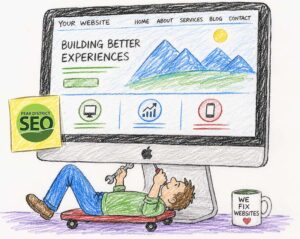
SEO is basically a service that you would buy and apply for the future of your website. It’s almost like having an on-site mechanic. I’m constantly there looking at your content, making sure that it follows best practices and that it’s as tuned up and optimal as it can be.
I try to also position myself as a critical friend for businesses. So I always encourage my clients to call me when they’ve got questions about how the site’s going, what they should do, and how they should be. Improving it, you know, on a sort of more informal basis, like we’re having this chat now.
I think it’s really important to have a good relationship with your clients for them to be frank and candid with me and tell me, you know, what they want to achieve. Then I can be frank and candid and say how realistic that is with the timescale and budget. You know, you’ve gotta be upfront with people, but at the same time, do all you can to make things happen.
Just give me a call or, if you prefer, you know, you can drop me the initial email if you prefer to make contact that way. And I will call you.
My main target audience at the moment is people who sell online via e-commerce websites. But I also am happy to help any business that needs to improve during this difficult time.
I’ve got quite a few. Customers who are who rely on high-volume leads. So if you are a chiropractor or a tree surgeon and you need that phone to ring and you don’t know why it isn’t, then it costs nothing to get in touch with me. And just. Get a summary of where your website’s at.
Mike: So during this outbreak, I believe you are offering free web audits. Is that correct?
Phil: Yes, We’ve all got enough on our plates without having to pay for something that you don’t actually know what you’re gonna get, so right now, if your website or your business is, is being affected by the coronavirus. Get in contact; I’m happy to spend a couple of hours on the initial audit before I reach back out to you. I’ll give that time freely to you to help you!
Mike: Great offer there, and with no obligation if they decide not to take it any further?
Phil: That’s absolutely right. There’s no obligation at all. You know, the point of having an audit is to know where the land lies. I try and come across as myself. You should be able to see that from the audit and from the video combined. If the time isn’t quite right for you to invest, then there’s always an opportunity later. Hopefully, you know, clients appreciate the way I’ve put myself across, ie no marketing BS.
Mike: Fantastic. Well, I think you’ve put yourself across extremely well. Phil, thanks for your time today.
So there you go. Phil Gregory from Peak District SEO. And if you want to take Phil up on his offer of a free audit for your website, his details were on-screen during the interview, and they’re also embedded into this social media post that you are watching.
So, tomorrow is Thursday, and we’ve had a lot of people asking us about their commercial business rent. And if we know anybody who can help and put you in the right direction in negotiating with your landlord. So tomorrow, I am talking to Mark Renshaw from Renshaw Chartered Surveyors, and Mark will be providing you with some help and advice and hopefully the help and advice that you.
So until tomorrow, all I’ve gotta say to you is stay safe, stay in business. And if at all possible, please stay at home. I’m Mike Marshall from Eatsleepthink, and you’ve been watching EST TV. Thank you.
If you’re looking for Graphic Design and a range of affordable websites with great support, speak to the team at Eatsleepthink
If you enjoyed this article, we think you might also like: – Make your website work for you.

I’m Phil Gregory, the MD and founder of Peak District SEO.
I’m an SEO & Google Ads Consultant with 28+ years of experience in I.T and helping UK Businesses improve website performance.
I built my first website in 1998, then I discovered the joys of website optimisation and never looked back.
If you want a no-nonsense, no-hard-sell approach and to actually get your website fixed with a solid, affordable, long-term approach, hit the contact button today.
Peak District SEO is a UK-based Digital Marketing Company.
We help businesses make more money, using traditional Search Engine Optimisation (SEO) , Ai Search / GEO and paid advertising (PPC).
Why Peak District SEO?
27+ years of experience.
80+ 5* reviews on Google
Our customers have hundreds of page one and position 1 rankings, and we can prove it.
We’ve helped hundreds of SMEs in the UK
We have numerous articles published across the web discussing SEO.
We regularly publish case studies about the work we’ve done
Customers trust our service – See our reviews on Google, Trustpilot and Facebook
Our customers have hundreds of page one and position 1 rankings and we can prove it.